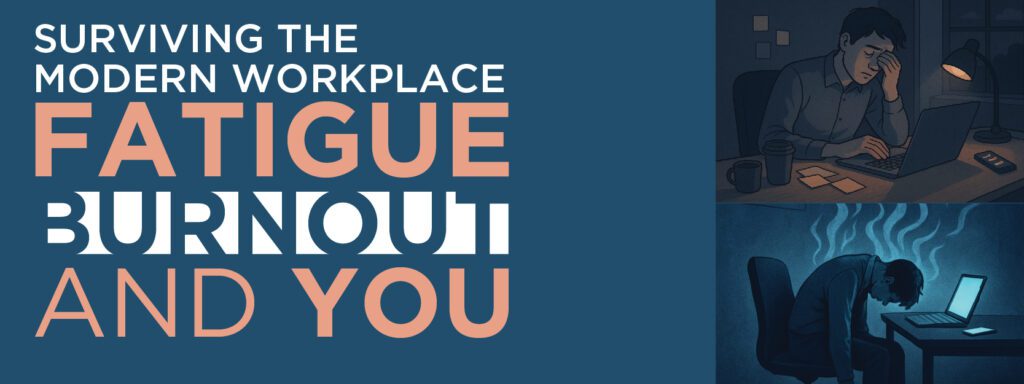
A generation ago, “working hard” meant showing up, doing your job, and heading home when the day was done. Work had boundaries, physical, emotional, and psychological. Today, those lines have faded. Being ‘committed’ now means checking emails in bed, taking client calls on vacation, and measuring our value by how much we can push through. Tired is normal. Overwhelm is expected. Rest is rationed, if not avoided altogether. We glorify productivity, yet behind the screen glow and busy schedules, a quiet erosion is taking place of energy, motivation, and well-being. People aren’t just tired anymore, they’re depleted. And few are stopping long enough to ask what it’s really costing us.
Fatigue, after all, is the everyday prose of office life, annoying but manageable with a nap, a weekend off, or stronger coffee. But burnout? That’s a different story. That’s when you are checking your emails and wonder if anyone would notice if you disappeared to a remote village to herd goats. That’s when even the thought of replying feels heavier than the email itself. Fatigue makes you daydream about a nap. Burnout makes you daydream about an entirely different life. And in today’s workplaces, where deadlines pile up faster than coffee cups, learning to tell the difference isn’t just helpful. It’s survival.
Since 2019, the World Health Organisation has classified burnout as a syndrome caused by chronic, unmanageable workplace stress. It is defined by three dimensions: exhaustion, cynicism, and reduced effectiveness. In plain English, it’s what happens when pressure never lets up, your control over how you work feels small, and even rest stops working. Put simply: Big Expectations + Little Control = Burnout.
Fatigue is temporary, the body’s signal to slow down. Burnout is prolonged, corrosive, and existential. Fatigue says, “Sleep in this weekend.” Burnout says, “Does this even matter anymore?” That distinction is critical—because too many of us brush off early signals until they’ve hollowed us out completely.
Recent surveys highlight the widespread impact of fatigue and burnout in the workplace. A 2024 study by Deloitte revealed that 77% of employees have experienced burnout in their current roles, with over half reporting multiple contributing factors. Similarly, the American Psychological Association’s 2023 Work in America Survey found that 77% of workers reported experiencing work-related stress in the past month, and 57% felt overwhelmed by their workload. Additionally, the National Safety Council reported that 97% of workers have at least one workplace fatigue risk factor, with over 80% having two or more, increasing the potential for job-related injuries. These statistics underscore the urgent need for organisations to address the underlying causes of burnout and implement supportive measures to enhance employee well-being.
The consequences extend far beyond the individual. Burnout bleeds into companies as absenteeism, lost productivity, and endless turnover. For society, it’s ballooning healthcare costs and fraying trust in institutions. The World Economic Forum estimates stress and burnout siphon more than a trillion dollars annually from the global economy, more than the GDP of many countries,vanishing like steam from that overworked coffee machine.
Yet despite the staggering cost, burnout often hides in plain sight because we’ve turned exhaustion into a badge of honor. We brag about all-nighters, wear eye bags like medals, and romanticize being “booked and busy.” Fatigue becomes proof of ambition, and collapse masquerades as dedication. In this culture, slowing down feels like failure. But the truth is simple: being tired all the time isn’t normal. It’s a signal. And signals aren’t meant to be ignored.
Research shows that burnout doesn’t just come from long hours; it comes from imbalance. When work feels unfair, unrewarded, or stripped of autonomy, the ground shifts beneath us. It’s not the single late night that breaks people; it’s the sense that they no longer have control, that the effort poured in doesn’t match what comes back. That mismatch between what we give and what we get is burnout’s breeding ground.
So what’s the way out? For individuals, small interventions can help: setting boundaries, building in genuine rest, and practising mindfulness. Nurses who tried mindfulness programs reported better sleep, more resilience, and less emotional exhaustion. Pausing, breathing, and re-centring are not luxury wellness trends; they’re survival skills in workplaces that won’t pause for us.
But solutions can’t rest solely on individuals. Workplaces need to rethink their culture of grind. Encouraging disconnection after hours, offering flexibility, and valuing quality over sheer volume all make measurable differences. Burnout is not solved by beanbags and pizza Fridays; it’s addressed by restoring balance, fairness, and humanity to the workplace.
Fatigue, on the other hand, can be fixed with rest, laughter, or a weekend nap. Burnout demands something bigger: a reset, a reevaluation, sometimes even reinvention. One asks for sleep; the other asks for change. That’s why it’s crucial to know which one you’re facing.
Author: MD. Nadim Ahmed
M.A. in English Language Teaching
Jahangirnagar University
Email: nadim@bangladeshbrandforum.com