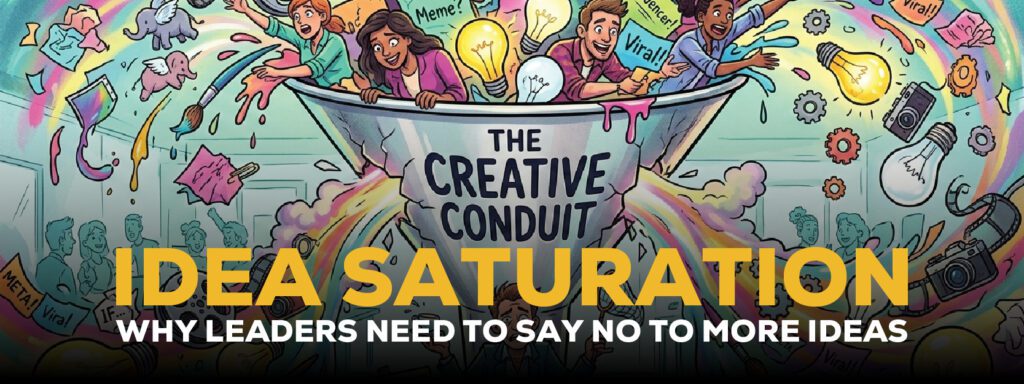
Picture a Monday morning briefing at any mid-sized advertising agency in Dhaka — or Dubai, or Delhi, or Dallas. The brief is on the table. The campaign deadline is looming. And yet, before anyone has sharpened a single strategy, a dozen directions are already being floated: a short-form video series, an influencer activation, a pop-up event, a meme campaign, a brand manifesto, a podcast sponsorship. Everyone in the room is brimming with ideas. And that, paradoxically, is exactly the problem.
This is idea saturation — the state in which an organisation is so overloaded with possibilities that it loses its capacity to execute any of them well. In the world of advertising, where creativity is the core currency, idea saturation is not just common. It is epidemic. And the leaders who refuse to acknowledge it are, quietly and consistently, the ones watching their best work drown before it ever reaches shore.
The Agency Brain on Overdrive
Advertising agencies are, by design, idea factories. Hire brilliant, restless minds, throw them a brief, and let the concepts fly. For decades, this has been the industry’s great superpower. But what happens when the factory never stops producing — when the conveyor belt runs nonstop and no one has the authority, or the nerve, to hit pause?
The result is a familiar chaos. Creatives burn hours developing concepts that never get presented. Strategy decks balloon to forty slides when ten would do. Clients receive three radically different campaign directions and, overwhelmed by choice, default to the safest one — or, worse, ask the agency to “combine elements from all three.” Timelines stretch. Budgets bleed. And somewhere in the wreckage of execution, the single great idea that should have led from day one gets buried under the avalanche of everything else.
Ritu Kapoor, Executive Creative Director at a leading integrated agency in Mumbai, puts it plainly: “We used to pride ourselves on how many ideas we could generate in a single brainstorm. Then we started asking how many of those ideas actually made it to air — and the number was embarrassing. We were mistaking volume for value.”
“We were mistaking volume for value.”
When ‘Yes And’ Becomes a Strategy Problem
The advertising industry has long borrowed its creative culture from improvisational theatre, where the golden rule is “yes, and” — accept every idea and build on it. In a brainstorming room, this philosophy is liberating. But brainstorming is not a strategy. And strategy demands discernment, not acceptance.
The shift from creative exploration to strategic clarity requires a different kind of leadership — one that is willing to say “no” not because an idea is bad, but because it is not the right idea for this brief, this brand, this moment. It is a distinction that many agency leaders intellectually understand, yet emotionally resist. Because in a culture that celebrates creativity above all else, saying no to an idea can feel like a betrayal of the very culture the leader has spent years building.
James Okafor, CEO of a fast-growing creative consultancy in Lagos, describes the tipping point he reached three years ago: “I had a team of twelve incredibly talented people, and we had more ideas in circulation at any given moment than we had bandwidth to develop. Every week we were starting new things and finishing nothing. The agency was creatively rich and operationally bankrupt. I had to learn, painfully, that my job wasn’t to say yes to great ideas. It was to say yes to the right one.”
The Hidden Cost Nobody Talks About
Agency leaders are comfortable talking about creative risk. They are considerably less comfortable talking about the cost of creative excess. But those costs are real, and they compound quietly until the damage is impossible to ignore.
Talent attrition. The most driven creatives do not leave agencies because the work is too hard. They leave because the work never lands. Developing three full campaign concepts for every pitch, watching half of them shelved before the client meeting, and cycling through this ritual month after month is demoralising in a way that no ping-pong table or Friday drinks can offset. When people feel their best ideas disappear into a void, they eventually follow them out the door.
Client trust erosion. When an agency presents too many directions, it signals something the client reads immediately, even if they cannot articulate it: the agency is not sure. Confidence is contagious, and so is its absence. Clients who sense uncertainty in their agency’s thinking begin to micromanage, second-guess, and ultimately replace the agency with one that walks in with a point of view.
Strategic dilution. Every hour spent developing idea number seven is an hour not spent deepening idea number one. The campaign that wins awards, changes brand trajectories, and gets remembered by consumers is almost never the campaign built from ten half-developed notions. It is the one that received the singular focus of a team that believed in it completely.
What Saying No Actually Looks Like
This is not an argument for creative conservatism. The most effective agency leaders are not the ones who narrow their teams’ imagination — they are the ones who channel it. There is an enormous difference between shutting down creativity and directing it.
In practice, saying no to more ideas requires three things that do not come naturally to most creative organisations. First, it requires a clear strategic filter — a set of criteria against which every idea must be measured before it receives time and resources. Not “is this interesting?” but “does this solve the actual problem?” Not “has anyone done this before?” but “can we do this better than anyone else, within the constraints we actually have?”
Second, it requires structural clarity about where creativity is encouraged and where it is not. The brief-setting phase should be expansive and exploratory. The concept-development phase should be focused and selective. Many agencies blur these stages, allowing the exploratory energy of brainstorming to bleed endlessly into execution — with predictable results.
Third, and most critically, it requires leaders who are willing to own the no. Not delegate it to a process, not hide it behind a framework, but stand in front of their teams and say: “Of everything we generated, this is the idea we are betting on. The rest were valuable to reach this point. Now we are going here, together, with everything we have.”
The brief-setting phase should be expansive. The concept-development phase should be ruthlessly selective. Most agencies blur these two — and wonder why nothing gets finished.
The Agencies Getting It Right
A quiet revolution is underway in some of the world’s most effective agencies. Not loudly — because the advertising industry tends to publicise its wins and bury its methodology — but unmistakably, in the shape of their work and the consistency with which they deliver it.
These agencies share a common characteristic: their leaders have built cultures where creative rigour is as celebrated as creative abundance. Where the ability to evaluate and eliminate is treated as a skill, not a limitation. Where the question “why this idea over all the others?” is answered with conviction before the idea ever leaves the building.
They also tend to present fewer options to clients. Not because they generate fewer ideas internally, but because they do the hard work of selection before the client room. They arrive with a recommendation, not a menu. And clients — starved for partners who will lead rather than merely supply — respond accordingly.
Sara Lindqvist, Chief Strategy Officer at a Scandinavian agency known for its restrained but razor-sharp output, describes their internal philosophy: “We allow ourselves to go wide early and deep late. But there is always a moment — usually in the second week of development — where we stop generating and start deciding. That moment is not comfortable. It is not meant to be. It is the most important work we do.”
The Harder Truth: It Is a Leadership Problem
Idea saturation is not a creative problem. It is a leadership problem. And it persists not because agencies lack smart people, but because the smartest people in the room are often the ones most reluctant to close doors.
There is a psychological comfort in keeping options open. Committing to a single idea means accepting that everything else won’t happen — at least not on this brief, for this client, in this window. For leaders who have built their identity around their ability to generate, that act of elimination can feel uncomfortably close to loss. But it is not loss. It is leadership.
The clients who become the industry’s most celebrated case studies — the campaigns that define a brand for a decade — are almost never the result of more ideas. They are the result of one idea, held with extraordinary conviction, developed with extraordinary discipline, and executed with extraordinary focus. The leaders who produced those outcomes had usually said no to dozens of other directions to get there.
As the industry accelerates — shorter cycles, fragmented platforms, AI-assisted production that makes it cheaper than ever to generate more — the pressure to pile on ideas will only intensify. Which means the leaders who master the discipline of subtraction will only become more valuable.
The Brief Has One Answer
Every great brief, at its core, has one answer. Not one option, one format, or one execution — but one fundamental truth about what the brand needs to say, to whom, and why. The creative agency’s job is to find that truth and give it the most powerful possible form. Everything else — every tangential concept, every “what if we also” — is noise.
Saying no to more ideas is not about being less creative. It is about respecting creativity enough to protect it — from distraction, from dilution, and from the well-meaning enthusiasm that, left unchecked, is the single greatest threat to brilliant work.
The best agency leaders already know this. The rest are still running more brainstorms.