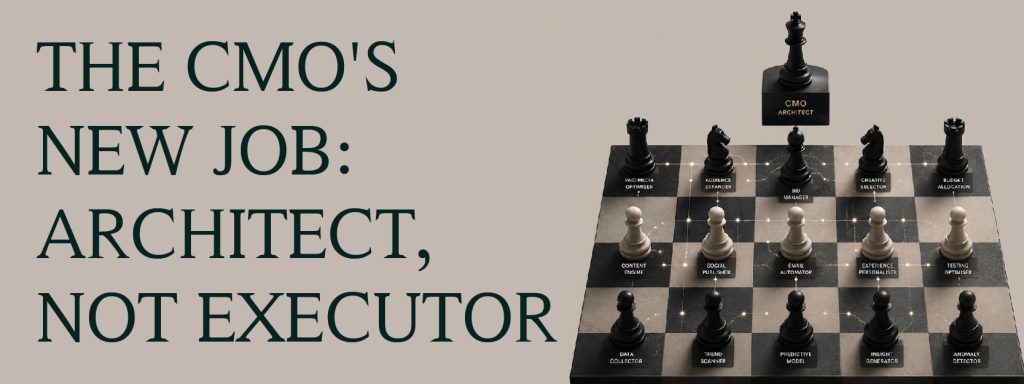
As AI automates more execution, the marketing organisation is flattening, team boundaries are blurring, and the CMO’s role is shifting from managing people to architecting systems. What that shift looks like in practice — the problems it surfaces, the skills it demands, and the strategies the best marketing leaders are building around it.
There is a telling statistic buried in the Spencer Stuart CMO tenure report for 2025: average tenure at S&P 500 companies has fallen to 4.1 years, the shortest since tracking began, yet 62% of departing CMOs moved into equal or larger roles. The number suggests something more interesting than simply a difficult job market. It suggests that the CMO role is being restructured around a different set of expectations, and that the leaders who are thriving in the new version are the ones who recognised the restructuring early — while the ones who did not are cycling through faster than their predecessors.
The restructuring has one primary driver. By December 2024, 73% of Fortune 500 CMOs reported that AI tools now handle tasks previously requiring teams of 15 to 20 marketing professionals. Email copy, ad creative testing, campaign optimisation, audience segmentation, content generation, reporting, scheduling — the execution layer of the marketing function is being automated at a pace that outstrips the organisational change happening around it. The result is a function that is operationally leaner, structurally ambiguous, and strategically more demanding than it has been at any point in the past two decades — and a leadership role that has not yet settled into a clear new form.
Understanding what that form is becoming, what problems it creates, and what the best marketing leaders are doing about it is one of the more consequential questions in business leadership in 2026.
| 68% of global CMOs believe AI will be the defining theme of 2026 — not as a trend or a tool, but as a structural transformation. For the first time in tracking history, CMOs rank digital and tech capabilities (45%) as the most important skill for the year ahead, outpacing leadership and team management.
The Drum / CMO Survey, January 2026. Marketing budgets have flatlined at 7.7% of company revenue (Gartner CMO Spend Survey 2025), with over half of CMOs reporting budgets below 6% — a threshold that limits simultaneous investment in talent, technology, and campaign scale. The CMO is being asked to do more with the same resources, in a structurally different role, with a different skill requirement than the one they were hired for. |
The problem hiding inside the efficiency gain
The surface story of AI in marketing is an efficiency story: tasks that took teams of ten now take teams of three, content that took six weeks to produce now takes seven days, campaigns that required manual optimisation now self-adjust in real time. Klarna compressed its image production cycle from six weeks to seven days using generative AI, reducing annualised marketing costs by $10 million. That is a real gain, and it is being replicated at different scales across marketing organisations globally.
The less visible story is what happens to the organisation when that efficiency arrives. When AI absorbs the execution layer, the middle of the marketing structure — the managers who coordinated between senior strategy and junior execution — finds its primary reason for existing has been automated. The traditional CMO spent approximately 60% of their time managing people, coordinating campaigns, and reviewing creative output. The emerging CMO spends the same proportion designing AI workflows, optimising algorithmic performance, and governing systems that operate largely autonomously. That is not an evolution of the same role. It is a different job, with different skills, reporting to the same title.
Marketing teams are discovering this in practice. At Google, Meta, and most mature marketing organisations, platforms like Performance Max and Meta’s Advantage+ now consistently outperform manually managed campaigns — and they do it without the marketer’s help. The targeting, the bidding, the creative selection, the audience expansion: the platform handles it, often opaquely, and often better. The paradox this creates is acute: marketing teams are busier than ever, managing an average of 47 different tactics across 11 channels, yet customer acquisition costs continue to rise because the activity is execution without architecture. The team is running the machine rather than designing it.
“We see marketers overwhelmed by AI tools promising everything. The winners are the ones using it strategically. Deploy AI where it removes friction — scheduling, data analysis, personalisation at scale — and keep humans where authenticity matters — strategy, storytelling, creative direction.”
— CMSWire, The CMO Survival Guide for 2026, April 2026
The governance gap compounds the structural one. As AI systems make more decisions autonomously — adjusting budgets, selecting audiences, generating content — the question of who is responsible for what those systems decide becomes genuinely difficult to answer. Brand safety failures, tone-deaf automated content, algorithmic bias in targeting: all of these are emerging as real risks in organisations that have automated execution without building the governance layer that tells the system where it cannot go. The CMO who has not built that governance layer is not just operationally exposed — they are reputationally exposed in ways that their predecessor, who controlled execution directly, never was.
The team is running the machine rather than designing it. That is the most common and most costly mistake in the AI transition — and it is happening inside organisations that consider themselves sophisticated adopters.
Dividing the labour correctly
The strategic response to this problem begins with a clear-eyed decision about where automation is appropriate and where human oversight remains essential. This is not a philosophical question but a practical one, and the organisations that are navigating the transition most successfully are the ones that have answered it explicitly rather than letting it resolve itself through accumulated tool adoption.
|
AI HANDLES |
HUMANS OWN |
|
Routine content generation — SEO pages, social variants, email sequences |
Brand narrative, tone of voice, and creative direction that makes the brand distinctive |
|
A/B testing at scale — hundreds of variants across channels simultaneously |
Deciding what to test and what success looks like beyond the numbers |
|
Campaign optimisation — budget reallocation, bid adjustment, audience expansion |
Strategic priorities that determine where budgets should point in the first place |
|
Data synthesis and pattern recognition across platforms and channels |
Judgment calls where incomplete data, ethical considerations, or brand risk require human oversight |
|
Personalisation at scale — adapting messaging to individual user behaviour in real time |
The stories, insights, and cultural intelligence that make personalisation feel human rather than algorithmic |
| Scheduling, reporting, and workflow coordination across teams and tools |
Crisis response, stakeholder management, and decisions where authenticity and accountability matter |
The labour division that effective CMOs are building in 2026 — adapted from Heinz Marketing AI Org Chart Framework (Feb 2026) and CMSWire CMO Survival Guide (Apr 2026). Low-risk, high-volume tasks qualify for full automation. High-risk areas — brand positioning, crisis communications, executive messaging — remain human-led.
The discipline required to maintain this division is more demanding than it appears, because the economic pressure consistently runs in the direction of automating more. When AI can generate a brand positioning document in four minutes, the temptation to let it is genuine — and the cost of doing so is often invisible until a competitor’s distinctiveness makes your own brand’s genericness apparent. Alex Hesz, global president of strategy and solutions at WPP, described the necessary duality with precision: the evolved CMO requires a deep, mechanical understanding of the underlying dynamics of large language models, in perpetual contact with an intuitive, empathetic understanding of the underlying dynamics of human beings. Only by knowing how those two behaviours can be managed toward a common business goal can effective marketing happen.
What architecting actually looks like
The shift from executor to architect is not primarily a technology decision. It is an organisational and strategic one, and the CMOs who have made it most successfully describe it in terms of three specific changes to how they think about the role.
The first is treating the marketing technology stack as a designed system rather than an accumulated set of tools. Most marketing organisations have built their technology infrastructure through a series of point-solution decisions — buying the best email platform, then the best analytics tool, then the best social scheduling tool — without designing how those systems communicate, share data, or produce coherent measurement. The result is what researchers at Heinz Marketing call disconnected point solutions: AI tools that are individually capable but collectively incoherent, generating conflicting data and requiring more human time to reconcile than they save through automation. The architect CMO designs the stack before populating it, defining how data flows between systems and what unified measurement looks like before selecting the tools that will produce it.
The second change is the introduction of what is being called human-in-the-loop architecture — the governance layer that defines where AI decisions require human review before execution. In practical terms, this means identifying the categories of decision that carry brand risk if automated incorrectly, building checkpoints into workflows where those decisions surface for human judgment, and assigning explicit ownership of the governance function rather than assuming it will self-organise. Payal Parikh, VP of client services at Heinz Marketing, describes this as calibrating the autonomy dial at the organisational level — deciding who controls how much autonomy the AI systems operate with, and building the accountability structures that mean someone is responsible when the dial is set incorrectly.
The third change is measurement. The CMO who governed execution had a relatively clear set of metrics: campaign performance, reach, frequency, conversion rates. The CMO who architects systems needs a different measurement framework, because the AI platforms that now execute campaigns have a structural incentive to claim credit for outcomes they did not cause. Attribution inflation — where platforms report returns that include sales that would have happened without the advertising — is now a documented and significant problem. The architect CMO builds measurement systems that triangulate across marketing mix modelling for strategic allocation, multi-touch attribution for tactical optimisation, and incrementality testing to verify net-new demand. The platform’s reported ROAS is one input among several, not the primary answer.
The skills problem nobody wants to say out loud
The honest version of the CMO transition story includes an uncomfortable observation: most CMOs were not hired to do the job that the AI transition is creating. They were hired for brand leadership, stakeholder management, creative judgment, and commercial strategy — skills that remain valuable, but which now need to coexist with technical fluency in AI systems, data architecture, and workflow governance that most marketing career paths have not developed. The CMO is being described, accurately, as the unofficial CTO with a storytelling edge — a role that combines deeply different skill profiles and assumes both can be found in one person.
The gap between what the role now requires and what most senior marketing leaders were built for is real, and the organisations pretending it is not are the ones cycling through CMOs at the rates Spencer Stuart’s data captures. The organisations addressing it directly are doing so through two routes: hiring specifically for technical fluency at the CMO level, or building dedicated AI orchestration roles — whether called marketing operations leaders, revenue operations partners, or AI workflow managers — that sit between the CMO’s strategic direction and the AI systems executing it. Neither route is without cost. But both are preferable to the default, which is a CMO managing 47 channels across a 15-tool stack with no one explicitly responsible for designing how any of it fits together.