Look at the budget of almost any large consumer brand and the priorities are easy to read. Advertising has its own line, its own agency, a media plan and a dashboard that reports every week. The moments where customers actually meet the brand, at the checkout counter, at the door when a delivery arrives, on a call to the helpline, are spread across departments that rarely think of themselves as brand builders at all.
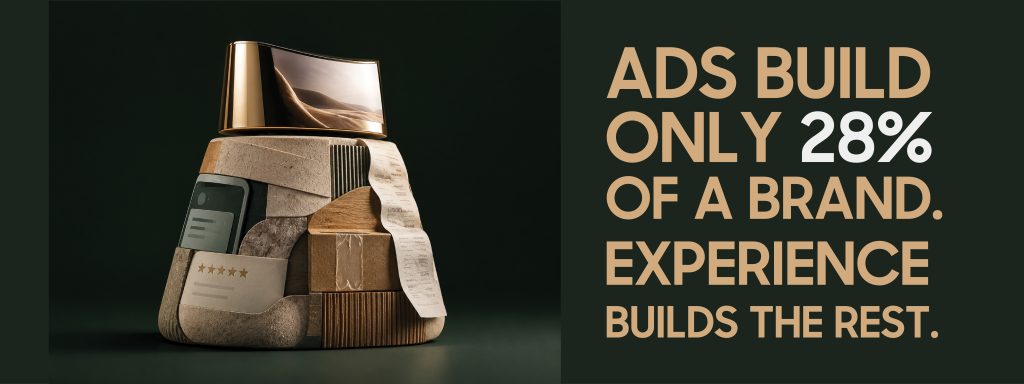
In June, branding agency JKR and research firm Kantar put a number on that imbalance. Their report, Be Distinctive Everywhere: The Experience Edition, launched at Cannes and draws on Kantar’s research into which experiences make brands feel meaningfully different. It found that paid media builds 28 percent of brand equity. Direct and indirect experience builds 71 percent: 30 percent comes from owned touchpoints, the things customers see and feel for themselves, and 41 percent from earned ones, what they hear from friends, family, reviews and social media.
The finding lands awkwardly for anyone who sets a marketing budget, because most budgets are built around the 28 percent.
The number behind the number
The 28 percent figure has a history. Kantar has tracked how different touchpoints contribute to brand equity for years, and an earlier analysis from the firm put paid media’s share at about 25 percent, with experience, word of mouth and related factors making up the rest. Its touchpoint research has also found that about 20 percent of touchpoints account for roughly 80 percent of brand impact. The new report adds a commercial consequence: brands that improve their customer experience and then amplify it are 2.5 times more likely to grow market share significantly.
The report also found that distinctive branding combined with customer experience does more to set a brand apart than communications or any other factor Kantar measured. Mark Chamberlain, Kantar’s global managing director for customer experience, said the research shows both how much experience contributes to brand equity and which touchpoints carry the most weight.
“Experience has been the underfunded, undermeasured side of brand building.”
Mark Chamberlain, global managing director, customer experience, Kantar
Both firms have an interest in this conclusion. JKR sells branding and experience design, and Kantar sells customer experience research. The numbers are consistent with Kantar’s earlier work, but readers should know who is making the case.
The 71 percent nobody owns
The harder problem is organisational. Advertising has an owner. The touchpoints that build most of a brand usually do not, at least in marketing terms. The store belongs to retail operations, the app to the product team, the delivery to logistics, the helpline to customer service and the invoice to finance. Each department runs to its own targets, usually cost and speed, and none of them is measured on what it does to the brand.
That is how a company can spend heavily on a campaign promising warmth and care while its call centre is judged on how quickly it ends calls. Customers experience both, and they believe the one they lived through. The earned share makes the gap wider, because a poor experience rarely stays private. It becomes a review, a comment or a story told over dinner, and at 41 percent, earned touchpoints are the largest single slice of brand equity in the study.

Improve, then amplify
The 2.5x finding has two parts, and the second keeps marketing firmly in the picture. Brands grew when they improved the experience and then made the improvement visible. Fixing a slow delivery service quietly helps the customers who happen to notice. Telling people about it, and giving them reasons to tell each other, turns an operational fix into brand equity.
KFC has become the report’s reference example. At a launch event in July, KFC’s Christophe Poirier joined Kantar and JKR to discuss how the chain treats every touchpoint, from the restaurant to the packaging, as a chance to reinforce what makes the brand different. JKR frames the approach as a cycle: a brand rooted in a clear belief, an expression that invites people in, and an experience that proves the belief true. A memorable store undone by a clumsy app breaks the cycle, because customers judge the whole chain of encounters rather than its best moment.
The postman problem
Some of the strongest touchpoints are people. Ogilvy’s Rory Sutherland has described how Royal Mail invested heavily in delivery reliability without measurably changing how much people liked the brand. What moved affection was whether people liked their postman. Sutherland calls the underlying habit quantification bias: companies invest in what they can measure easily and neglect what matters but resists a dashboard.
The lesson reaches well beyond the post office. Delivery riders, shop assistants and agents behind counters rarely appear in a brand plan, yet for many customers they are the brand.
Why advertising still matters
It would be easy to read 28 percent as a reason to cut ad budgets, and that would misread the study. Advertising builds the awareness that brings people to the experience in the first place, and it shapes what they expect when they arrive. A great product nobody has heard of builds very little equity. The report’s own growth finding depends on amplification, which is advertising’s job.
The better reading is about balance. Advertising makes a promise, and experience decides whether people believe it. A brand that advertises well and delivers poorly is paying to invite people into a disappointment, then paying again when they tell others about it.
There is a newer reason to care as well. The report notes that AI systems increasingly form their picture of a brand from the same experience touchpoints, drawing on reviews, complaints and customer conversations. When an assistant summarises a brand, it reads what customers have lived, and advertising is only part of that record.
The Bangladesh test
In Bangladesh the case may be stronger still, because many of the country’s biggest brands are built on experience more than on advertising.
For millions of people, a mobile financial services brand such as bKash or Nagad is the agent at the corner shop. Whether that agent has cash on hand, counts it honestly and treats customers patiently shapes the brand more than any television campaign. For delivery and ride-hailing platforms like Pathao and Foodpanda, the rider is the brand’s most frequent face, and a late or careless rider can undo an expensive campaign in a single evening. Banks and telecom operators are judged in branch queues, call centres and SIM replacement desks, often when customers are already stressed. For consumer goods companies, the experience is the product and the shelf it sits on, usually in neighbourhood shops the brand does not control.
Earned touchpoints carry unusual weight here too. Bangladeshi consumers share experiences quickly through Facebook groups, family WhatsApp chats and conversation, so one bad encounter with an agent, rider or helpline travels far beyond the customer who had it. If earned touchpoints build 41 percent of equity globally, their share may be at least as high in a market this connected.
Few local companies are organized around that reality. Marketing departments own the campaigns, while agents are managed by distribution teams, riders by operations and helplines by service divisions, each with separate targets. The useful question for local brand leaders is what share of the brand budget goes to advertising, and who owns the moments where customers actually meet the brand. A sharper version asks which touchpoint they would fix first if they could move a slice of the ad budget into it. For most, the answer will sit outside the marketing plan.
Bangladeshi brands grew up spending heavily on television, billboards and, more recently, social media. The next gains may come from investing in agents, riders and shelves with the same seriousness.
Where the rest of the brand lives
The JKR and Kantar numbers will be debated, as they should be. The direction they point in is hard to dispute. Customers form their view of a brand from everything it does, and advertising is the part a company controls most tightly and measures most carefully. That is exactly why it gets the budget, and why the other 71 percent is so often left to chance. The brands that grow will treat every customer encounter as brand building and fund it accordingly.
Author: MOHAMMAD SIFAT