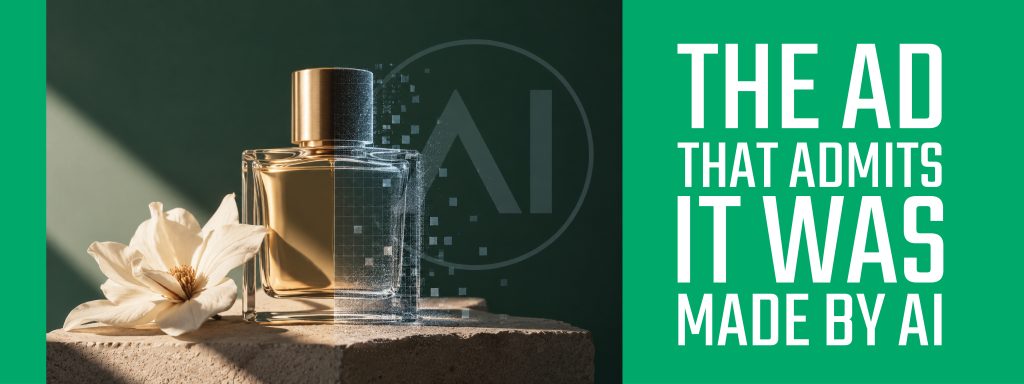
An advertisement has always told you whose it was. It never told you how it came into being: whether the photograph took three days to shoot or three minutes to generate, whether the model was a person or a prompt. That stayed with the agency.
This year the line started to move. Google now lets advertisers mark images and videos as AI-generated or AI-edited, and on Search, YouTube and Discover that information can appear under “How this ad was made.” Google labels some work made with its own tools automatically. Meta’s “About this ad” panel now surfaces AI use, including outside tools where Meta can detect them, and TikTok asks advertisers to declare commercial content that AI fully generated or significantly altered. Advertising is gaining a provenance layer, a record of how each piece was made that travels with the work.
Each change looks minor on its own. Together they move information that used to stay backstage into the consumer’s view, and that leaves brands with a question the compliance team cannot answer: once people can see that AI was involved, what will they conclude about the brand that used it?
Advertisers like AI more than audiences do
IAB research published in January found that 83 percent of advertising executives said their companies used AI somewhere in creative work, against 60 percent two years earlier. Cost efficiency was the benefit they cited most, named by 64 percent. Consumers have noticed the shift, and 71 percent of Gen Z and Millennial respondents believed they had already seen AI-made advertising. Executives also overestimate how warmly it lands. Eighty-two percent believed Gen Z and Millennials felt positive about AI-generated ads, yet only 45 percent of those consumers said they did. Gen Z was the most sceptical group, with 39 percent negative against 20 percent of Millennials. Consumers were also more likely than advertisers to link brands that use AI with words such as manipulative and inauthentic.
The same study complicates the obvious reading. Seventy-three percent of young respondents said clear disclosure would either increase their likelihood of buying or change nothing, and more than half wanted to know when an ad was fully AI-generated. People can dislike AI advertising and still want to be told about it.
Trust and clicks can pull apart
When Yahoo and Publicis Media tested disclosure on more than 1,200 American consumers, respondents who noticed the label rated the ads 73 percent more trustworthy, and their trust in the company rose 96 percent. Finance and healthcare, where credibility matters most, showed the strongest effect.
Researchers at NYU Stern and Emory University found a different pull on performance. Fully AI-generated ads beat both human-made and AI-modified versions, lifting click-through rates by up to 19 percent in field tests. Telling viewers that AI was involved cut effectiveness by up to 31.5 percent.
| OUTCOME | WHAT DISCLOSURE DID | SOURCE |
| Perceived trustworthiness of the ad | Rose 73 percent when the label was noticed | Yahoo and Publicis Media |
| Trust in the company | Rose 96 percent | Yahoo and Publicis Media |
| Click-through rate | Fell by up to 31.5 percent | NYU Stern and Emory University |
| Purchase likelihood | Up or unchanged for 73 percent of young consumers | IAB |
Disclosure moves each measure differently. A brand that tracks only one of them will misread the effect.
Both results hold. A disclosure can make a company look honest and still make one particular ad less persuasive. The meaning also shifts with the brand. “Created with AI” on a technology launch supports the story. On a handmade luxury product it contradicts what the brand sells, and on a healthcare ad showing a patient it leaves the viewer wondering which parts of the person are real.
Where assistance ends and authorship begins
A photographer shoots a model and AI removes the background. A tool suggests fifty headlines for a copywriter’s concept. An actor’s voice gets translated into four languages. The model is synthetic but the clothes are real, or real footage sits inside a generated setting. Each involves AI, yet few people would call all of them AI-made. IAB’s disclosure framework, released in January, answers with a materiality test: disclose AI when it meaningfully affects authenticity, identity or representation in a way that could mislead. Retouching and routine production help need no label; synthetic people and cloned voices do. Label everything and audiences stop reading. Label too little and the brand looks evasive when the method surfaces later. The disclosure problem starts before anyone writes the wording, because someone first has to decide where assistance ends and authorship begins.
Two brands, two opposite bets
Coca-Cola’s AI-assisted remake of “Holidays Are Coming” drew heavy criticism online in 2024, and the company made another AI version for 2025 anyway. Islam ElDessouky, its global vice-president of creative strategy and content, told Marketing Dive the ad ranked among Coca-Cola’s best-tested work, performing strongly on brand association and conversion to purchase. The people arguing about the ad online were not necessarily the people buying the drink. Visibility alone did not settle the argument either. Consumers knew AI was involved, criticised the decision, recognised the brand at once and still responded to the ad.
“It scored off the charts.”
Islam ElDessouky, Coca-Cola, on its AI-assisted holiday advertising, speaking to Marketing Dive
Other brands have gone the other way. Aerie has committed to avoiding AI-generated bodies and people, and Coterie has said it will keep AI imagery out of its social marketing. Le Creuset has taken to clarifying when unusual-looking social posts came from a human artist, and in late 2024 Zevia mocked Coca-Cola’s AI holiday work in a campaign linking synthetic advertising to artificial ingredients. Once synthetic imagery becomes normal, human-made work turns into a claim a brand can make. For decades brands competed over what went into the product; they may now compete over what went into the advertisement. A technology company may gain from showing its AI; a brand built on craft or real people may gain more by leaving it out.
A patchwork of rules
Regulators are pushing in the same direction, though no single global label exists. Under the EU AI Act, from 2 August 2026, AI-generated content must be machine-readable as such, with visible disclosure required for deepfakes and some public-interest material. India’s IT Rules, amended in February, require labelling and traceable metadata for synthetic content on platforms. New York requires ads featuring AI-generated synthetic performers to say so. The platforms’ own systems run across all of these markets regardless of local law.
Technical standards finish the picture. C2PA and similar systems let information about how a file was made travel with the file itself, so the record survives after an ad leaves the agency. The old production process ended when the final artwork was exported. The new one may have to keep a record of how that artwork came to exist.
The Bangladesh question
Bangladesh has no disclosure regime of this kind, but local brands will meet platform labels and foreign rules whenever they advertise abroad. Agencies producing work for regional clients will need to know, long after a campaign has left the designer’s screen, which parts were generated and which were only edited. The bigger issue sits closer to home. Suppose an agency can now deliver for Tk 3 lakh what once took a Tk 20 lakh shoot. The client will want to know. The consumer probably won’t care about a retouched background, but a synthetic face presented as a real customer is a different matter. For routine help, the client may be the only party with a real interest. When AI creates a person, a voice or an event that the audience will take as real, the consumer has a claim too.
Agencies and brands can settle these questions before anyone settles them on their behalf, by defining what counts as material AI use and keeping provenance records instead of stripping them from final files. That requires no stance on AI itself, only a clear view of what the brand is willing to ask people to believe.
The label is only the start
AI will soon sit inside so much commercial production that “Was AI used?” stops being a useful question. The better questions are where it was used, what it changed, and whether knowing that would alter how a reasonable person understands the ad. The brands that handle this well will know what disclosure means to their own audience and category, and will decide on purpose. Disclosing everything by reflex, or avoiding AI altogether, is a decision by default. For the first time, an advertisement may have to explain how it was made.
Author: HUMAYRA TASNIM