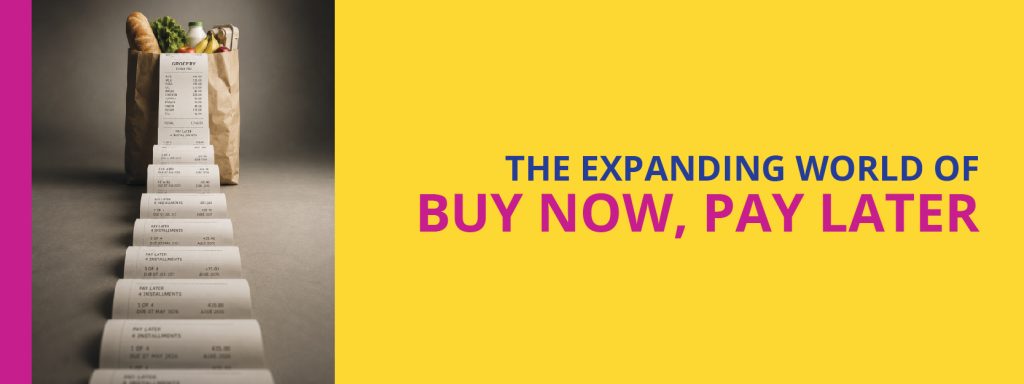
BNPL was sold as a smarter way to afford things you want. What the 2026 data shows is something different: it is increasingly how people afford things they need — and a growing number cannot keep up with the payments. When 25% of users are financing their weekly food shop, the consumer credit system has crossed a threshold that deserves serious attention.
Eight thousand taka for a month of groceries in a Dhaka household of four. On a salary of twenty-five thousand, after rent, transport, and utility bills, that number arrives at the end of the month with very little left behind it. A few years ago, the answer was to borrow from a neighbour, run a tab at the local shop, or simply buy less. In 2026, the answer is increasingly a tap on a screen — a checkout option that splits the amount into three or four instalments, requires no paperwork, and promises no interest if the payments arrive on time. Buy now, pay later has come to Bangladesh, and it has come at a moment when household budgets are under more pressure than they have been in a decade.
Bangladesh’s BNPL market reached $1.17 billion in 2025, growing at an 18.1% CAGR since 2022, with bKash, Pathao, and a growing number of fintech platforms embedding instalment options into everyday checkout flows. By 2026, the market is projected to reach $1.31 billion — and by 2031, $2.06 billion. Those numbers reflect genuine demand. They also reflect a consumer population that is discovering, as counterparts in the US, UK, and Australia discovered before them, that a product designed for convenience can quietly become a crutch — and that the transition between the two is rarely visible until it is already complete.
The global evidence for that transition is now substantial enough to constitute a finding rather than a warning. LendingTree’s 2026 BNPL survey, drawing on over 2,000 US consumers, found that 29% of BNPL users have financed groceries through the service — more than double the 14% rate from two years earlier. Among Gen Z users, that figure rises to 38%. Among parents with children under 18, 62% describe BNPL not as a financial convenience but as something they could not make ends meet without. These are not people who found a smarter way to manage their cash flow. They are people whose cash flow does not reach the grocery aisle — and what begins as a payment tool becomes, at that point, a form of consumer debt in a necessity category.
Understanding what this shift reveals — about household financial stress, about the design of fintech products, and about the regulatory gap that is widening in Bangladesh and globally — is the purpose of this piece.
|
METRIC |
DATA (2025–2026) |
|
Global BNPL market (GMV) |
$560.1 billion in 2025 — up 13.7% year-on-year. CAGR of 21.7% from 2021–2024. |
|
Global BNPL users |
~380 million in 2024; projected to reach 670 million by 2028. |
|
BNPL for groceries (US) |
25% of all BNPL users — nearly double the 14% rate from one year earlier. Among Gen Z: 33%. Among parents with children under 18: 38%. |
|
Late payments (2026) |
47% of BNPL users paid late in the past year — up from 41% in 2025 and 34% in 2024. A 13-point rise over two years. |
|
Cannot make ends meet |
54% of all BNPL users say they could not make ends meet without BNPL. Among parents with children: 62%. |
|
Multiple simultaneous loans |
Gen Z leads in loan stacking, with 29% of Gen Z users having held three or more BNPL loans simultaneously — the highest of any age group. |
|
Average transaction value |
$135 per BNPL transaction (CFPB, 2025). Average late fee: $9.99 per missed payment. |
|
Phantom debt problem |
BNPL debt is largely invisible to credit bureaus. Most providers do not report on-time payments, making the full debt burden of BNPL users unknown to lenders. |
| Bangladesh BNPL market |
$1.17 billion in 2025 — growing at 18.1% CAGR 2022–2025. Projected $1.31 billion in 2026. Expected to reach $2.06 billion by 2031. |
Sources: LendingTree BNPL Report 2026 (Mar–Apr 2026) · Richmond Fed Economic Brief No. 26-05 (Feb 2026) · Chargeflow BNPL Market Statistics (Apr 2026) · Morgan Stanley AlphaWise Survey (Apr 2025) · ResearchAndMarkets Bangladesh BNPL Databook Q1 2026 (Feb 2026) · CFPB BNPL Market Report (Dec 2025)
How a convenience product became a necessity
Buy now, pay later’s original value proposition was simple and appealing: spread the cost of a purchase you want to make across several payments, interest-free, without the friction of a credit card application. Klarna, Afterpay, and Affirm built significant businesses on this premise, primarily in fashion and electronics — categories where the purchase is discretionary, the amount is meaningful, and splitting the cost makes the decision feel more manageable. BNPL financed 6% of global e-commerce in 2024, up from 2% in 2020, growing at a pace that few consumer finance products have matched.
The expansion into groceries did not happen because BNPL providers strategically targeted essential spending. It happened because the economic conditions of 2022 through 2026 — persistent inflation, stagnant real wages, rising interest rates on conventional credit — drove consumers toward whatever credit was accessible, frictionless, and nominally free of interest in the short term. The average family of four in the United States now spends approximately $1,430 per month on food under a moderate-cost plan, according to USDA estimates. When that figure represents a larger share of take-home income than it did three years ago, and when BNPL is available at checkout with a single tap, the behaviour makes a certain economic logic — even if the financial consequence of it does not.
“If BNPL usage were to grow rapidly later this year, when we expect consumers to be more stretched due to elevated inflation from tariffs and slow income growth, we would potentially take that as a warning sign.”
— Sarah Campbell, Analyst, Morgan Stanley Research, April 2025
What the Morgan Stanley analysis identified as a potential warning sign in 2025 has become a documented reality in 2026. Monthly BNPL spending per user grew approximately 21% between June 2024 and June 2025, according to Empower Personal Dashboard data. The categories driving that growth have shifted decisively toward essentials: groceries, household goods, and food delivery now sit alongside electronics and clothing as the most common BNPL purchase categories. The shift is not incidental to the product’s design — it is the product responding to demand that has been created by economic conditions the product itself did not cause, but which it is now amplifying in ways that deserve examination.
The phantom debt that credit bureaus cannot see
The structural problem with BNPL’s expansion into essential spending is not primarily the interest rate, which for short-term pay-in-four products remains zero if payments are made on time. It is the invisibility of the debt it creates. Because most BNPL providers do not report on-time payments to the major credit bureaus, the obligations that BNPL users are accumulating are largely invisible to lenders, to employers who conduct credit checks, and to the users themselves when they apply for conventional credit. Bloomberg described this as phantom debt as early as 2024 — debt that exists on fintech balance sheets but does not appear in the credit infrastructure that the financial system uses to assess consumer risk.
The consequence is a specific and compounding hazard. A consumer carrying three simultaneous BNPL loans — a situation that applies to 29% of Gen Z BNPL users, the highest rate of any age group per LendingTree’s data — has a total debt obligation that no individual lender can see when they apply for a further credit product. The bank considering a personal loan, the credit card issuer reviewing an application, the landlord conducting a rental credit check: none of them has visibility into the web of instalment obligations that may already be straining the applicant’s monthly cash flow. This information asymmetry benefits nobody. It allows consumers to overextend without warning, lenders to underestimate risk without knowing it, and regulators to monitor a debt market that is structurally designed to be opaque.
The late payment data makes the strain visible in the only way available to it — retrospectively, after the financial damage has begun. LendingTree’s 2026 tracker found that 47% of BNPL users had paid late on at least one loan in the past year — up from 41% in 2025 and 34% in 2024, a rise of 13 percentage points over two years. That trajectory — six points in a single year, sustained across two consecutive years — is the kind of movement that indicates something structural rather than cyclical. Steve Rhode, a debt analyst who has tracked consumer credit stress for two decades, put it directly: when people use installment loans for groceries and then can’t keep up, that’s not a BNPL problem. That’s a budget problem that BNPL made visible.
Groceries are consumable. You eat them. If you are taking out an instalment loan for food and then falling behind on that loan, you have paid a premium — late fees plus stress — for groceries you already consumed.
The late fee arithmetic compounds the problem in ways that are easy to underestimate. The average BNPL late fee is $9.99 per occurrence, according to the CFPB’s December 2025 market report — a figure that sounds minor in isolation. A consumer carrying four or five simultaneous BNPL loans, which the data shows is not unusual among younger users, can generate $40 to $50 in fees from a single difficult week where multiple payments slip. That is the cost of groceries from two months ago, paid again, in penalty charges, while next month’s grocery bill is already at checkout waiting for the same solution that produced the previous problem.
| 47% — the share of BNPL users who paid late on at least one loan in the past year. Up from 34% in 2025 and 34% in 2024. The trajectory, not the level, is what matters.
LendingTree BNPL Tracker, March–April 2026. 54% of all BNPL users say they could not make ends meet without these loans. 62% among parents with children under 18. The original product promise — interest-free convenience for discretionary purchases — no longer describes how the majority of users are actually using the product. |
What this means for fintechs, retailers, and the brands enabling the model
The BNPL industry’s response to rising late payment rates has been characteristically fintech in its framing: the product works as designed, the problem is consumer financial literacy, and the appropriate response is better disclosure rather than structural change. That framing is becoming harder to sustain. When more than half of your users describe your product as a financial lifeline rather than a payment convenience, the original design premise — that this is a tool for consumers with money who prefer to spread payments — has been overtaken by the reality of how the product is being used.
For retailers who have embedded BNPL at checkout, the calculus is increasingly uncomfortable. The conversion lift that BNPL delivers — BNPL users spend approximately 6% more than non-BNPL shoppers — has been the primary commercial justification for offering it. But that conversion lift is being driven, in a meaningful share of cases, by consumers who are spending beyond what their income supports, financed by credit that will either be repaid at the cost of other necessities or will generate late fees that further erode their financial position. The retailer that accepts BNPL for groceries is not offering a service to a customer who prefers to spread payments. It is extending credit to a customer who cannot afford the groceries otherwise — and the regulatory and reputational exposure of that position is not trivial.
“BNPL is shifting beyond discretionary retail into groceries, healthcare, education, and travel, making repayment discipline more critical. This broadening use case raises new regulatory red flags around consumer overextension.”
— Chargeflow, BNPL Market Report, April 2026
The regulatory response is arriving — unevenly, with different speed and ambition across jurisdictions. The EU’s revised Consumer Credit Directive, being implemented across member states through 2026, formally brings BNPL under regulated credit frameworks, including affordability checks and standardised disclosures. The UK’s Financial Conduct Authority is implementing BNPL regulation from July 2026, introducing creditworthiness assessments and consumer protection requirements. Australia has ended prior exemptions and brought BNPL providers under the National Consumer Credit Protection Act. The US picture is more fragmented: the CFPB withdrew its 2024 interpretive rule in 2025, signalling regulatory ambivalence at the federal level even as states pursue their own approaches.
The common regulatory direction across all of these frameworks is toward treating BNPL as credit — with the affordability checks, disclosure requirements, and consumer protections that credit carries — rather than as a payment tool that happens to involve deferred obligations. That shift will reduce the frictionlessness that has driven BNPL adoption, and it will disproportionately affect the users who have been relying on BNPL for essentials, since those users are the ones least likely to pass a formal affordability assessment for a $75 grocery instalment. The regulatory response to the consumer stress problem may, paradoxically, remove the credit access that is currently cushioning households whose income does not reach their grocery bill.
Bangladesh: Where BNPL Is Growing and Oversight Is Not
Bangladesh’s BNPL market is valued at $1.17 billion in 2025 and is growing at an 18.1% CAGR — fast enough to double in size within five years under current trajectories. The projected value for 2026 is $1.31 billion, rising to $2.06 billion by 2031. The key players include bKash, Pathao, and a growing number of fintech startups and e-commerce platforms offering instalment options at checkout. The structural conditions that have driven BNPL’s expansion into essential spending in Western markets — persistent inflation, stagnant real wages, high household financial stress — are present in Bangladesh in more acute form than in most of the markets where the regulatory concern about BNPL has been most loudly expressed.
The regulatory gap is significant. There is no specific legislation targeting BNPL financing in Bangladesh. The National Digital Payments Roadmap mentions BNPL schemes as part of e-commerce and fintech payment models, but the legal framework governing consumer protection, affordability assessment, and disclosure requirements for BNPL products remains incomplete. BNPL providers in Bangladesh typically operate through partnerships with non-bank financial institutions or banks, using lightweight or algorithmic credit checks rather than formal affordability assessments. The invisibility of BNPL debt to the credit reporting infrastructure — already a problem in markets with mature credit bureaus — is more acute in a market where formal credit history data is limited for a large share of the population.
The population most likely to use BNPL for essentials in Bangladesh is the same population most likely to be financially vulnerable to its failure modes: young adults without access to formal credit, households in urban areas managing rising food costs on fixed or informal incomes, and consumers whose financial buffers were eroded by the inflation of the past three years. Bangladesh’s BNPL market presents a genuine opportunity for financial inclusion — bringing credit access to populations historically excluded from formal lending — but that opportunity and the risk embedded in it are not separable. A product that offers credit without affordability checks to households that are already financially stressed is not primarily a financial inclusion tool. It is a high-growth consumer finance product in a market without the consumer protection framework to match its growth rate.
The Bangladesh Bank has been expanding its oversight of digital financial services and fintech payment infrastructure, and the integration of BNPL into the National Digital Payments Roadmap suggests regulatory awareness of the sector. What is not yet visible is a policy response that addresses the specific risks of BNPL as consumer debt — the phantom debt problem, the late fee dynamics, the affordability assessment gap — rather than simply accommodating BNPL as a payment innovation within an expanding digital finance ecosystem.