How Gen Z reveals things slowly, and what that quiet strategy means for work and brands.
You can tell your colleague is up to something. A vague “big things loading.” A profile photo quietly swapped. A side project they will not quite explain. Ask straight out and you get a smile, not an answer.
They are not hiding. They are soft launching.
Gen Z reveals things slowly now. They hint before they announce. They test the water before they tell the world. The big, all-at-once version has a name too. The hard launch. Most of the time, this generation would rather whisper first.
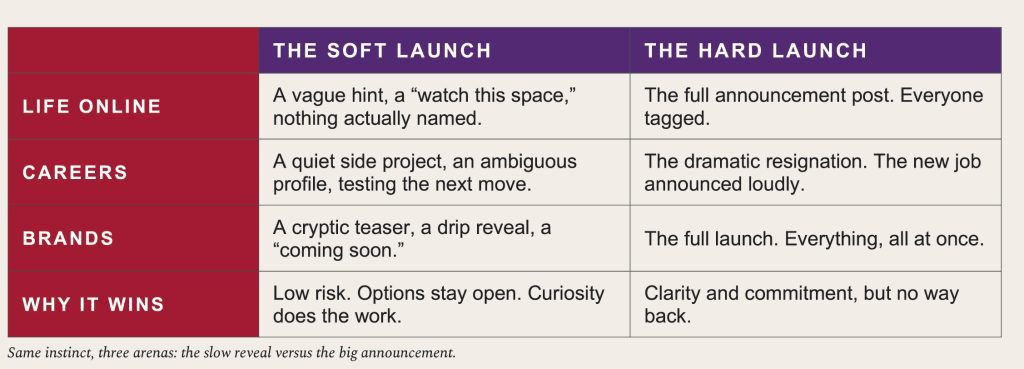
The phrase comes from marketing. A soft launch is when you release something quietly, to a small audience, before the full public debut. Gen Z took that logic and pointed it at everything. A new job. A new look. A new plan. Reveal a little. Watch the response. Commit only once you are sure.
Here is the thing. Soft launching was never really about being coy. It is about not getting caught out.
THE GENERATION THAT STOPPED ANNOUNCING
Gen Z grew up fully documented. Every plan, every win, every opinion posted in real time. They also watched what happened when those public declarations did not pan out.
The loud announcement that had to be quietly deleted. The “so excited to share” post that aged badly by month three. The bold plan everyone remembered after it fell through.
They learned the lesson. Announce something publicly and you own it publicly. If it falls apart, so does your feed.
So they stopped announcing. A soft launch is easy to walk back. Post a hint, not a headline. Nobody has to ask what happened to the big thing you never actually named.
Read that as cowardice if you want. It is closer to risk management. A generation raised on screenshots decided that not everything needs a press release.
In Bangladesh the stakes run higher. Do anything publicly here and you are not just updating followers. You are answering to a family group chat, a row of relatives, and a wider circle that forms opinions fast and remembers longer. The soft launch is armour. It lets you build something quietly before the whole network has thoughts about it.
This is not a small habit. It is a way of moving through the world. Reveal slowly. Commit late. Keep your options open until you are sure. You can see it in how they post. You can see it just as clearly in how they work.
SOFT LAUNCHING THE CAREER
Watch how a young employee leaves a job now. They rarely storm out. They soft launch the exit.
First a course on the side. Then a “personal project” that stays vague. A profile photo quietly swapped. A LinkedIn that drifts from open to ambiguous. By the time anyone notices, they are halfway out the door, and the new thing is already real.
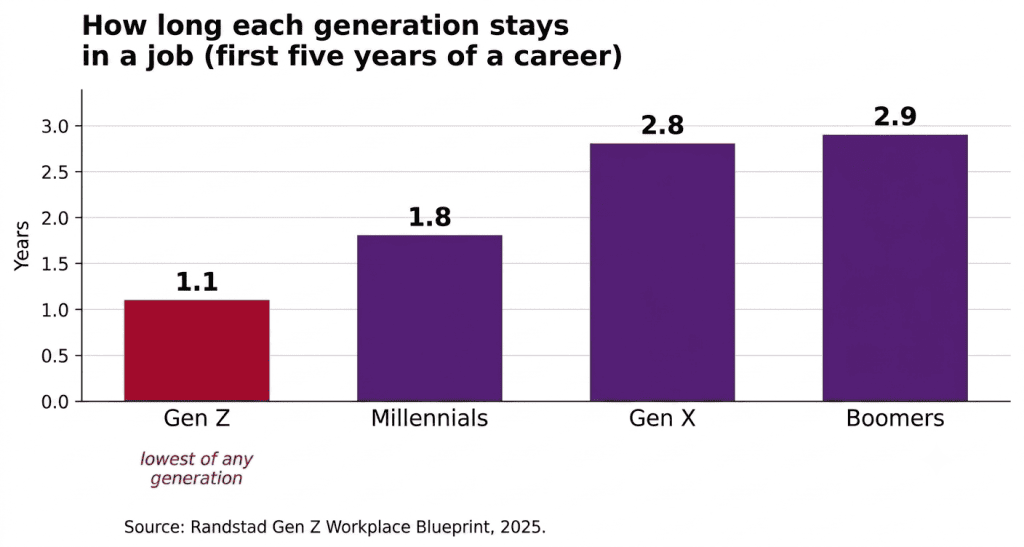
The numbers are striking. Randstad found that Gen Z stays in a job for an average of 1.1 years across the first five years of their careers. Millennials managed 1.8. Their parents stayed close to three.
It is not that they are flaky. HireClix found 54 percent of Gen Z planning to leave their current job, up from 30 percent the year before. But they are not slamming doors. In a frozen entry-level market, most are doing the careful version: holding the job they have while quietly testing for the next one.
Glassdoor has a name for the mindset. The “career lily pad.” You hop to whatever fits right now, and you stop pretending any single job is forever. The old deal traded loyalty for security. Gen Z watched that deal break, so they treat work as temporary and keep their real plans on soft launch.
For managers, this changes the game. You will not get a dramatic resignation. You will get a polite one, weeks after the real decision was made. The signals are small and easy to miss. The quieter someone goes, the more it is worth paying attention.
The fix is not surveillance. It is giving people a reason to hard launch their commitment to you. Gen Z hops when they cannot see a path. Show them one, and the soft launch of their exit never starts.
BRANDS WERE DOING THIS FIRST
Here is the irony. Brands taught everyone to soft launch.
The teaser campaign is a soft launch in a suit. A cryptic post. A shadowy product shot. A countdown that tells you nothing and somehow makes you care. Apple built a religion on it. Marvel drops ten seconds of footage and lets the internet write the rest.
It works because of a quirk in the brain. We hate unfinished business. Psychologists call it the Zeigarnik effect, the way an open loop nags at you until it closes. A good tease leaves the loop open. You lean in. You guess. You wait.
For a generation that already thinks in soft launches, this lands perfectly. Gen Z does not want the billboard. They want the breadcrumb. They want to feel like they found the thing, not like the thing was sold to them.
Bangladeshi brands already live by this. The market runs on Facebook, where a page can tease a drop to a few thousand followers and let the comments do the rest. A blurry product shot. A “coming soon.” A date with no details. The F-commerce seller and the global fashion house are playing the same game.
Smart brands lean in further. Drops land on “close friends.” Reveals arrive in pieces. The audience plays detective, and the detective work is the marketing. A fashion label can post a single close-up, a texture, a buckle, a colour, and let the comments spiral for a week before the product even has a name.
But there is a trap, and it is a big one.
THE REVEAL HAS TO BE WORTH IT
A soft launch makes a promise. Something good is coming. Wait for it.
Break that promise and you pay. Tease for weeks and deliver a dud, and the same audience that leaned in will turn on you. Marketers have a blunt phrase for the bad version: psychological phishing. All mystery, no reward.
The attention you are borrowing is thinner than ever. The teasing only works if the reveal earns it. Drag it out and people stop caring. Plenty of brands burn the goodwill by day four and start posting “something’s coming” into a void.
Gen Z can smell this instantly. They have soft launched their own lives. They know the difference between a real slow reveal and a stall. You cannot fake the payoff to the people who perfected the format.
WHAT THE SLOW REVEAL IS REALLY SAYING
Strip away the cropped photos and the cryptic captions, and the soft launch is one simple demand. Let me reveal things on my own terms.
That is what Gen Z asks in their everyday life. It is what they ask of work. It is what they expect from the brands they let in.
They are not hiding. They are waiting to be sure. They go public when the thing has earned it, and not a moment before.
For everyone trying to reach them, the lesson is the same. You do not get the hard launch for free. The employer, the brand, the big moment: each one has to be worth the full reveal.
The generation that reveals slowly is being careful, not difficult. And it is quietly teaching the rest of us to earn the moment it finally goes public.
Author
TASNIM SAFWAN