In 2021, Swedish fashion brand H&M faced a dramatic backlash in China. Their comments about alleged forced labor in Xinjiang sparked a wave of consumer anger. Overnight, the brand vanished from major Chinese e-commerce sites. Stores were boycotted. Celebrity ambassadors dropped them. And in one of their biggest markets, H&M not only lost sales but also lost control of their story.
This wasn’t just a marketing misstep; it was a wake-up call about our changing world. We’ve entered a phase of fractured globalisation.
For years, global brands thrived on the idea that markets around the world would converge, with shared tastes, values, and shopping carts. But that belief is fraying. Political flashpoints, trade wars, cultural disconnects, and rising nationalism are pulling at the seams. The once-universal brand playbook now shows cracks.
Today, brands can’t assume every market is interchangeable. What worked everywhere is now a risk. To stay relevant and survive, brands must rethink how they communicate, behave, and connect in each location they operate.
The End of Global Uniformity
In the past, globalisation felt like magic for brands. Launch a product in Tokyo, then mirror it in Toronto, same packaging, same tagline, same ad campaign. Repeat worldwide. This was efficient, predictable, and controlled. But that illusion is fading.
Today, trade isn’t just about moving goods; it’s a political tool. Take the U.S.–China tariff wars: suddenly, manufacturing costs climbed, product prices shifted, campaigns were delayed, and launch plans got scrapped. Companies rushed to renegotiate supplier deals across Asia. The message was crystal clear: the old models don’t hold.
Add to that protectionism gaining ground. India, Indonesia, and Brazil they’re all tightening rules for foreign players. In Europe, digital data regulations and supply chain transparency standards are rising. No global campaign can afford to ignore these layers.
The bottom line: one-size-fits-all campaigns don’t fit anymore. A London campaign dropped into Seoul might be polite, but it can also feel tone-deaf. Global brand managers who stick their heads in the sand risk losing trust and missing opportunities that come from tailoring.
Local Relevance is No Longer Optional
Buying a product is no longer just a transaction; it’s a statement of identity. And identity is deeply tied to where you live, what you’ve been through, and what matters to you.
In China, consumers demand brands that align with national pride. Any hint of criticism and they strike fast. India? Brands are expected to understand local beliefs in content and pricing. “Made for India” isn’t a tagline; it’s expected. Even in the U.S., a single social post or campaign can spark honest political reaction.
Words that feel inspiring in one market can feel hollow or insensitive in another. A background color or a gesture that’s cheerful in one country might offend elsewhere. Subtle symbols carry weight.
That means translation isn’t enough. You need local voices. Local teams. Local creators. People who know the cultural reference points to craft messages that feel seen and heard.
It’s not retreating, it’s listening and adapting. Swap rigid global comms for local-to-person connection. The goal isn’t dilution of brand, it’s resonance. If global awareness is shallow, emotions won’t take root.
The Political Risks of Global Branding
Brand messaging isn’t floating in peaceful air; it’s navigating a political minefield.
Remember the U.S.-China trade standoff? One day, you’re running full ad campaigns in Asia; the next, everything’s halted. Some brands deliberately moved media spend off Chinese platforms. Others paused ads to dodge backlash.
Now, even staying quiet has implications. Silence can be misread as apathy, or even opposition; brands are expected to signal something. Every slogan, partnership, or social media mention is parsed for political meaning.
This isn’t just a PR challenge. It’s a strategic one: Which influencers do you hire? Which ad channels do you buy? And how do you anticipate regulatory triggers in your marketing mix? Today’s communication teams need geopolitical sense as a core skill because missing subtle context can spell ruin.
Supply Chains and Operational Rethink
Global brands once leaned on China for cost, speed, and volume. It was a reliable machine.
But now, that bet brings risk. Trade wars. Pandemics. Rising labor costs. Plus, what if public opinion turns toward origin? Suddenly, your supply chain isn’t just about money, it’s about reputation.
That’s why nearshoring and regional diversification are surging. Yes, costs might tick up, but you gain flexibility. Quicker shipping. Easier audits. Fewer currency or tariff headaches.
Consumers care about origin. They ask, “Where was this made?” Operational choices feed into brand trust. They also give story potential: “we co-manufactured with local artisans,” “we sourced ingredients nearby.” And if a rule comes down, your logistics setup lets you pivot quickly.
So supply chains aren’t support systems anymore, they’re part of the brand story. They’re front‑line decisions.
Digital Borders and Regulation
The digital world isn’t seamless anymore. Every market is carving its own rules.
Take data laws: GDPR sets Europe on edge. Now, Canada, Brazil, India, and maybe even China data need careful handling. So a global campaign that relies on big data will need local data teams, localised compliance, and localized tech.
Next: content. What flies in Brazil’s social media scene? It might be blocked in Vietnam. And remember: YouTube, Facebook, and Instagram, these platforms are restricted in China. Meanwhile, TikTok is banned in some U.S. agencies.
One-size digital doesn’t scale across borders. Media buying, ad platforms, ad tech, everything needs regional adaptation. Regulatory teams are as important as creative teams now.
What Must Change in Global Brand Strategy
The old model, a single global campaign pushed everywhere, is dead.
Brands need modular strategies: a core brand truth intact, but flexible in execution. Think global DNA, local accents.
Here’s how to make it work:
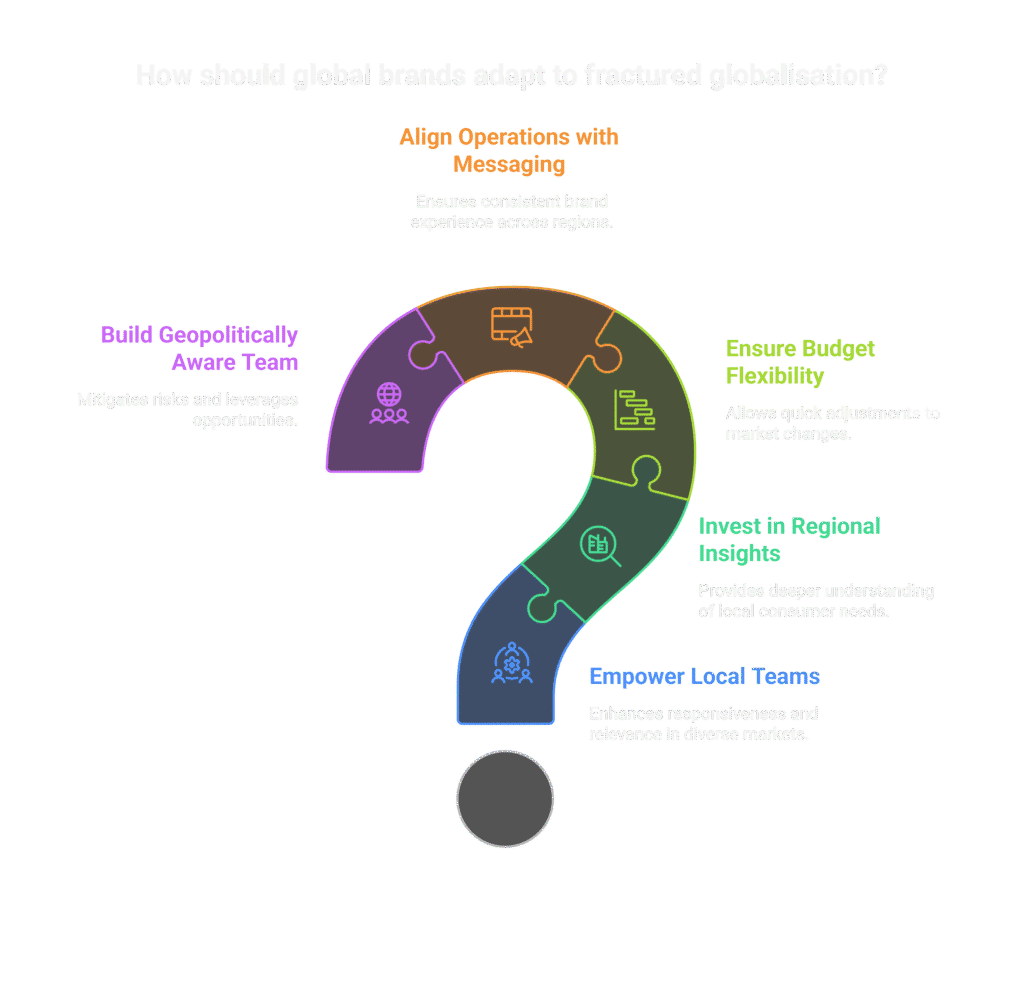
- Shift structure.
Give local teams decision-making power. Global creative HQ sets big themes, but local teams tailor how it’s said. This step prevents misfires and speeds up the response. Your Seoul team spots a cultural nuance; your Lima team highlights a local holiday. - Invest in regional insight.
Don’t use global surveys to drive regional plans. That rarely lands. Instead, go for regular local research, quarterly market focus. Hire local marketers, storytellers, and ethnographers, not just translators. - Budget flexibility.
Fund local content, local creators, and local testing. This doesn’t equal fragmentation; it equals relevance. Your savings from skipping personalisation could cost more in negative sentiment down the line. - Align operations and messaging.
Use your supply setup as a storytelling asset. A European-made product can tout “heritage” labelling or sustainability. Nearsored items can lean on “faster delivery, lower carbon.” - Build a geopolitically-aware team.
Brand leaders and marketing pros need a geopolitical radar. Preferred hires? Those who’ve lived internationally or advise governments. Or invest in training on international relations and trade trends.
The Payoff: Closer Connection, More Trust
This isn’t about fragmentation, it’s about precision.
Done right, a localised brand strategy does more than navigate risk; it unlocks deeper consumer connection. People feel seen. They feel understood. They believe voices at their local level matter.
Localised marketing has real ROI from higher engagement to fewer PR crises. I’ve seen brands go from vague global messages to local campaigns that users share with pride. That user’s share? That’s priceless.
These campaigns spark conversations, spark brand love, not backlash.
Fractured globalisation is here to stay
This isn’t a temporary phase. It’s the new normal.
The world is more divided politically, culturally, and digitally than it’s been in decades. Brands that cling to outdated global playbooks are already out of sync.
Global uniformity looks efficient on the balance sheet, but it kills nuance. It makes companies brittle. It wastes resources on crisis management. It divorces the brand from the people it needs to serve.
Adapting doesn’t weaken the brand; it strengthens it by making it real, one market at a time.
Final word
Global branding used to mean one strategy for all. That ended years ago.
Now, global brands must operate as global networks united in purpose, but fluent in context. They must empower local teams, speak the local language, and feel local feelings. They must adapt operations like supply chains and digital structures to reflect human expectations.
To meet consumers where they are, brands must first understand where they stand and what matters to them. Those who refuse to change will find themselves defending old habits in a world that has moved on.
The future? It’s not about being everywhere. It’s about being meaningful everywhere by speaking with empathy, curiosity, and care for local hearts and minds.
Author: Nusrat Jahan