When Apple launched its privacy campaign with massive black-and-white billboards reading “Privacy. That’s iPhone.”, the message was unmistakable. No list of features. No product specs. No sales pitch. Just a bold statement tied directly to the brand. That kind of clarity doesn’t happen by accident. It’s what brand recognition looks like in the wild.
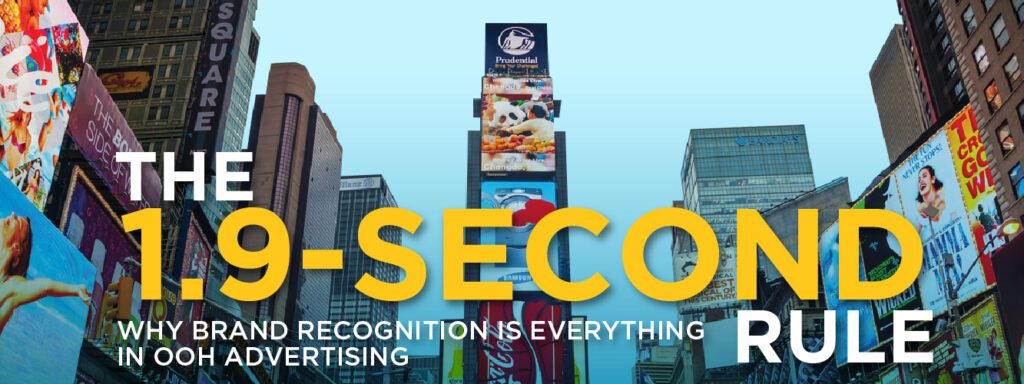
Out-of-home (OOH) advertising exists in a fast-moving, chaotic environment, with blaring horns, blinking lights, and shifting crowds. There’s no luxury of time or attention. OOH doesn’t get to unfold like a story. It needs to strike like a match. The average person spends 1.9 seconds on an OOH ad. That’s barely enough to blink, let alone process complex messaging.
But is it enough time to connect the dots: brand, message, and memory? If that connection doesn’t happen instantly, it won’t happen at all.
The 1.9-Second Rule
This isn’t a marketing metaphor; it’s a data-backed reality. Eye-tracking research and field studies consistently show that 1.9 seconds is the upper limit for most outdoor ads. In busy urban settings, that number often drops closer to 1.5 seconds. We’re talking about drive-by glances, not engaged viewing.
So, the job of the ad isn’t to explain. It’s to trigger a memory, a feeling, a brand link. Within that tiny window, recognition has to hit. If it doesn’t, the brand doesn’t just miss a message. It misses its moment.
OOH doesn’t reward clever wordplay or subtlety. If a viewer needs time to understand the ad, that time doesn’t exist. The creative either lands instantly or vanishes without a trace.
This is where a lot of brands fall short. They aim for clever. They aim for artistic. But unless that cleverness comes with immediate recognition, it’s wasted effort.
Brand Recognition Is Crucial
OOH ads function in a space where attention is fleeting. The brand that doesn’t shout its identity gets forgotten, not because it was bad, but because it was invisible. Recognition isn’t just a win in OOH. It’s the entire game.
OOH doesn’t drive clicks or sign-ups. It builds memory. It creates familiarity. The best campaigns understand this and go all-in on visual branding. Not storytelling. Not persuasion. Just sheer recognizability.
In digital ads, success might mean conversion. In OOH, success means the viewer can recall the brand a week later. And that’s only possible when the branding shows up instantly and powerfully.
It’s easy to overthink this. Some brands try to get cute with metaphors or abstract visuals. Others bury their logos in fine print or choose minimal layouts without any defining brand elements. But ambiguity is a luxury OOH can’t afford.
The Mechanics of Instant Recall
Memory doesn’t form by chance. It forms through consistent, repeated patterns. That’s how the brain works. Think of Coca-Cola’s red. Or the golden arches of McDonald’s. Or the Nike swoosh. These are more than logos. They’re signals. And when someone sees them, even without context, they know exactly what brand is speaking.
OOH design must strip away the unnecessary. No excess words. No busy backgrounds. No layered metaphors. The creative should answer one question instantly: Who is this from?
That’s not a constraint. That’s a competitive edge. A distinctive brand code lets one say more with less. One does not need a sentence when a shape, a color, or a font can do the work.
This is where design discipline pays off. Ads that stick to a defined identity system train the viewer’s memory. With each repetition, recognition strengthens. Over time, you don’t just notice the ad, you know who it’s from before your brain finishes reading it.
Creative Restraint
The most effective OOH ads show, not tell. A single ketchup packet and the McDonald’s logo. A blank red background and the Coca-Cola bottle shape. A blue square with a white “f,” and everyone knows it’s Facebook. These work because they cut straight to recognition.
Restraint doesn’t mean being boring. It means cutting the clutter so the core message of the brand is impossible to miss. Every element in an OOH ad must earn its place. If it doesn’t help with immediate brand recognition, it’s in the way.
Frequency, Placement, and Context Matter
Great creative alone won’t win in OOH. Placement, repetition, and context shape effectiveness just as much. A killer ad placed once in a random location won’t drive recognition. But the same ad, seen five times in five different places, becomes hard to forget.
Repetition builds memory. When someone sees the same identity repeatedly on bus shelters, subway walls, and roadside screens, it embeds. Not because the message changes, but because it doesn’t. Consistency beats novelty here.
OOH lives in physical space. And physical spaces come with built-in meaning. The right message in the right place, seen enough times, creates an emotional and cognitive link.
Digital OOH
Digital OOH (DOOH) brings new creative possibilities, but at the same time, constraints still rule. Just because a screen can show animation, that doesn’t mean it should. The viewer still only glances. The creative still has to land instantly.
In fact, DOOH raises the bar. Competing against other screens, traffic, signage, and movement makes standing out even harder. That means your ad needs to simplify even further. One key message. One strong visual. One instantly recognizable brand cue.
Too often, brands treat DOOH like a web banner. They load it with transitions, product shots, headlines, and secondary CTAs. But the 1.9-second rule doesn’t bend for technology. If the brand doesn’t register at a glance, the viewer is gone.
Motion can help, but only when it enhances clarity. If animation delays the logo or distracts from the brand signal, it hurts more than it helps. Movement should draw attention, not require it.
The best DOOH ads use their flexibility wisely. Rotate static frames. Highlight a key product. Reinforce brand colors. But never complicate what needs to be simple.
What Smart Brands Get Right
The smartest brands don’t reinvent the wheel every time. They sharpen it. They don’t chase novelty. They pursue familiarity. Not because they lack creativity, but because they understand the job. Their creativity doesn’t just speak, it signals. Instantly. Clearly. Repeatedly.
Award-winning design means nothing if people don’t know who it’s from. Great campaigns work because they’re unmissable and unmistakable. The message lands because the brand is loud, proud, and ever-present.
OOH advertising isn’t about shouting the loudest. It’s about being the fastest to stick. In the end, that’s what makes people remember you long after the ad disappears.
Author: Nusrat Jahan