
Natalie Wills, who runs brand marketing and creative at Expedia Group, put the logic of her company’s biggest creator deal in one comparison. A creator’s audience, she told Campaign, is made of people actually choosing to spend time watching, while a lot of marketing channels now feel more like an interruption. Most advertising has to fight its way into someone’s attention. A creator with a loyal following already has it.
That reasoning explains why, in April, Expedia named IShowSpeed its official travel partner for a year. The 21-year-old livestreamer, whose real name is Darren Watkins Jr., has more than 150 million followers, split roughly evenly across YouTube, Instagram and TikTok. His travel streams have already taken him through China, Africa, India and Australia, with millions watching him improvise his way through each country in real time.
Speed framed the partnership in his own terms. Travel, he said at the launch, should be for everybody, and many of his fans come from places where seeing the world does not feel possible. For Expedia, that line did more work than a tagline could, because it came from the person the audience already trusted.
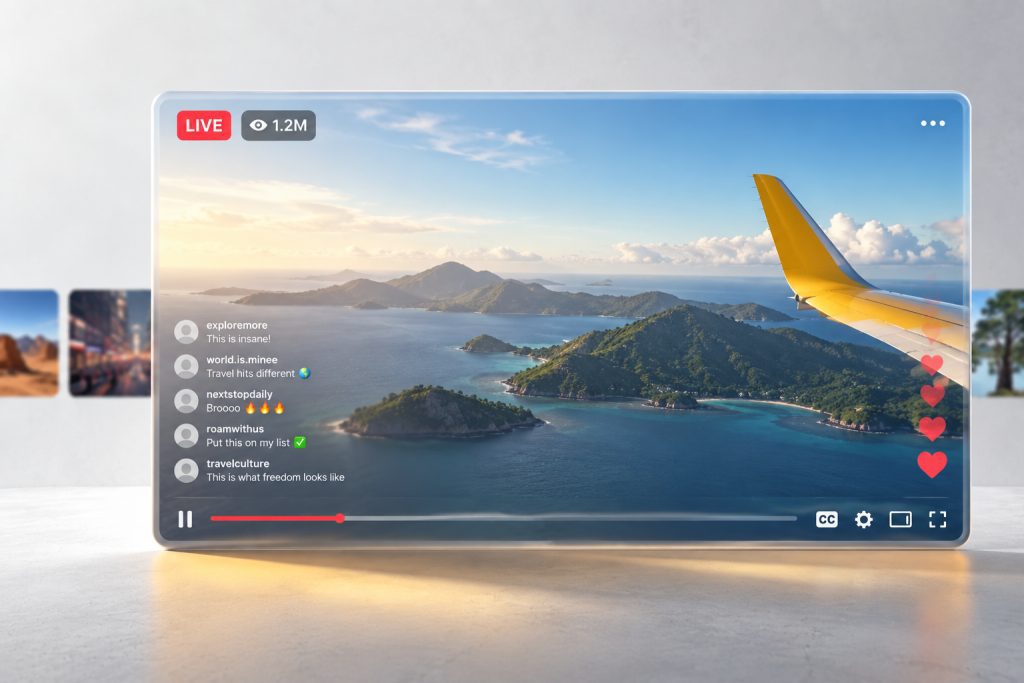
The partnership opened on 29 April with a 15-hour livestream in which Speed island-hopped across five Caribbean countries in a single day, by plane, boat, jet ski and dune buggy, most of them painted Expedia yellow. Expedia says the stream and the content around it reached more than 400 million people. In the days that followed, searches on Expedia rose 70 percent for Sint Maarten, 50 percent for Guadeloupe and 35 percent for Dominica. Those are the company’s own figures, and a search is not a booking, but they suggest viewers did more than watch.
The launch was not improvised on Expedia’s side. Lauri Metrose, the company’s senior vice-president of global communications, told Digiday that preparing for the stream was intensive, with logistics planned around a creator whose content depends on things going unplanned.
A channel with a personality
What makes the deal unusual is how little it resembles a conventional endorsement. Expedia was folded into travel videos Speed was already making for his audience, rather than writing him into a scripted advertisement. Wills has said the arrangement was built as a partnership from the start, not a campaign where a creator is brought in at the end. The brand appears as the infrastructure behind his travel, the thing that gets him from one island to the next, and never as the subject.
The second phase, launched at the end of June, pushed from attention toward sales. A 90-second film called Going Places with IShowSpeed follows him across the United States alongside a yellow, Expedia-branded mannequin standing in for the viewer, and it links to Exspeedia.com, a shoppable map of the places and activities from his streams. The travel trade publication Skift described the goal plainly: turn the awareness from the livestream into bookings.
Expedia declined to disclose the cost. A source familiar with deals of this size told Digiday they would estimate it at around $250,000. Digiday read the arrangement as a sign that some brands now see mega creators as always-on audience channels rather than campaign placements. Speed provides the audience, the content and the cultural moment, and Expedia builds its paid media, website and follow-up campaigns around what he produces. In effect, one person has become the centre of a year-long media plan.
The content then travels well beyond the original stream. Clips from each broadcast circulate for weeks on the creator’s own channels and on fan accounts, and the second phase deliberately translated his spontaneity into a cinematic format built for social and premium video, aimed at mass reach. The livestream is the source material, and the rest of the plan is built from it.
The wider market is moving the same way. IAB forecast US creator ad spending of $37.1 billion in 2025 rising to $43.9 billion in 2026, and in April it reported that more creator budget now goes to paid amplification of creator content than to the partnerships themselves. Brands are treating good creator content as a media asset to be tested and pushed across channels. When that content comes from a single, very large creator, the partnership, the creative and the media plan start to merge.
The opposite bet
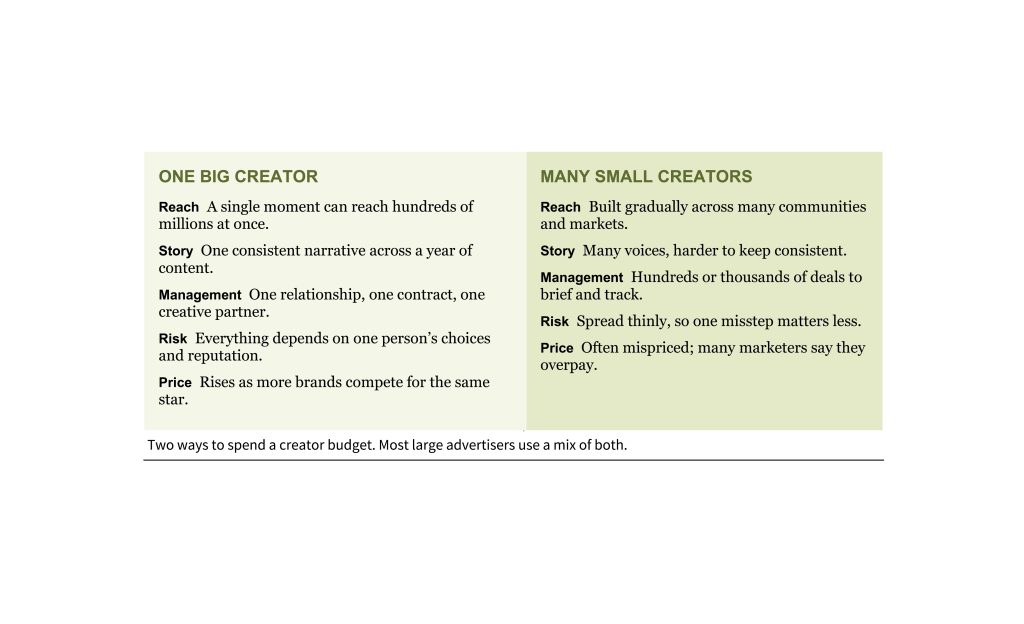
Most large advertisers are heading the other way. Unilever, for example, now works with hundreds of thousands of creators, spreading budget across local voices in many markets. Linqia’s 2026 State of Influencer Marketing report found that 92 percent of marketers intend to work with both macro and micro creators. Spreading the money limits the damage any one person can do, lets brands test many messages at once and reaches communities a global star never will.
Spreading budget has its own problems. Research from the creator agency Billion Dollar Boy found that about half of marketers struggle to price creator fees correctly and around 40 percent believe they have overpaid. Managing thousands of small deals takes systems, staff and measurement that many brands still lack.
A single mega creator offers something different: a moment large enough to become news, a consistent storyline that runs for months and one relationship to manage instead of thousands. The two models answer different questions. Many small creators help a brand become familiar in many places. One large creator can make a brand part of an event people talk about.
 Longer deals, bigger titles
Expedia is not alone in concentrating its bets. Digiday reported in August that sunglasses brand Blenders has signed its biggest partnership yet, a multi-year arrangement that gives a creator an executive-style title. The company said his first major video exceeded all its internal targets. Not everyone is convinced by the titles: one talent industry executive told Digiday that many such C-suite appointments are simply partnerships with a fancier name.
The same shift shows up in how brands contract creators. Digiday described the lavish influencer brand trip, often costing high six figures, as a format under strain, and pointed instead to longer arrangements such as Air France and Rent the Runway’s month-long partnership, contracted for 37 posts. Budget is moving from single spectacular events toward sustained relationships with output written into the agreement.
 The risk sits in one person
Concentration cuts both ways. A livestream is unpredictable by design, which is part of its appeal, and Speed himself says his streams cannot be overplanned. Skift reported that Expedia executives acknowledged reputational risks tied to his past controversies, alongside the value of giving the creator control. A brand that builds its youth marketing around one person inherits that person’s every decision for the length of the contract.
There is also a pricing problem. Speed works with brands in travel, audio, insurance, gaming and consumer technology, and one analysis noted that because no single sector owns him, his asking price keeps rising. The more successful the model becomes, the more brands compete for the same handful of creators large enough to carry it.
Multiple sponsors create a quieter risk as well. Audiences who watch a creator promote a travel site one week and a phone or an insurance product the next may start to see every appearance as a paid one. The value of the creator’s endorsement depends on audiences believing that his choices are his own.
Measurement remains the weak point. Reach figures and search spikes show interest, but a year-long deal eventually has to show bookings. Expedia appears to be hedging. It already runs a wider creator marketing operation, and executives have signalled openness to adding more macro creators if the approach proves itself.
What the bet really buys
The strongest argument for the model is fit. Expedia chose a creator for whom travel was already the content. Wills has described him as someone who immerses himself in each culture and brings millions of viewers along in unscripted streams, which makes travel feel accessible to a young audience that might never have considered visiting the Caribbean. The brand did not need to invent a reason to be there.
The second argument is timing. Expedia has said its goal is to build early brand affinity with the younger audiences who are shaping the future of travel. Many of Speed’s viewers are not yet booking trips. The company is paying to be the name they remember when they start, a long-term brand bet that a single quarter’s bookings will never fully capture.
That suggests a simple test for any brand tempted to build around one creator. Would the creator make this content even without the sponsor? If the answer is yes, the brand can become part of something the audience already chooses to watch. If the answer is no, the result is an expensive advertisement with a famous face attached, and the audience will recognise it as one.
Author: RIFAT AHMED