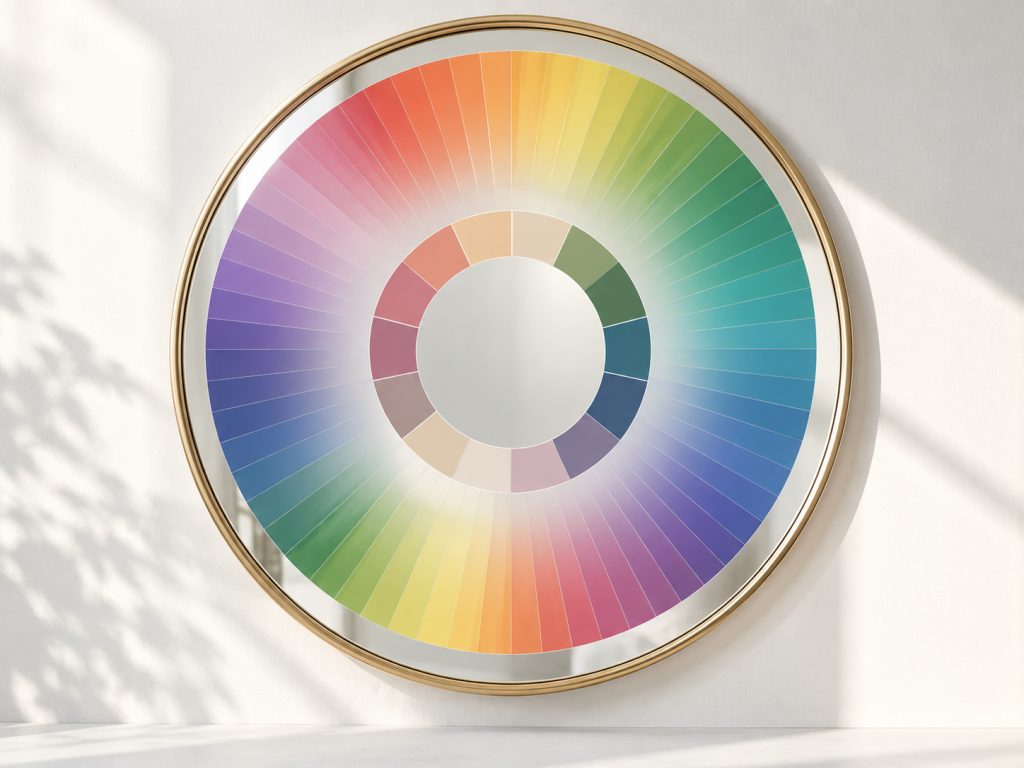
The consultant starts with questions, not colours. What do you usually wear? What would you like to change? Is there an interview or a wedding coming up? Only then does the measuring begin. In many Seoul studios a spectrophotometer reads the brightness, redness and yellowness of the client’s skin before any fabric appears. Then come the drapes, more than 120 of them, held one after another beneath the chin while the consultant watches the face. Some shades make dark circles recede and the skin look clearer. Others drain it.
An hour or so later the client leaves with a season, a palette and often a printed report. A one-to-one session typically starts at around 100,000 won. Converted, consultations in Korea run roughly $80 to $160, while a three-hour session at a well-known studio in Brooklyn costs $545.
For decades this was a discreet service for politicians, chief executives and the social elite. It has since become one of the most sought-after experiences in Seoul. One American visitor told Time that she booked her colour analysis before planning almost anything else, then called more than 30 studios before she found a slot. Personal colour content has drawn about 375 million views on TikTok, and the Korea Tourism Organization has used the trend to court foreign visitors.
Korea’s entertainment exports did much of the early marketing. Sohee Baek, a stylist at Color Society in Hongdae, has said that foreigners watching Korean shows and dramas during the pandemic kept hearing personal colour mentioned and grew curious enough to book when travel reopened. The studios did the rest, adding English-speaking consultants and interpreters as demand from abroad grew.
Paying for fewer options
On its face, colour analysis is about clothes and lipstick. Underneath, it answers a problem every modern shopper recognises. There are too many shades, formulations and styles to test, and each wrong guess costs money. A survey for CeraVe found that 80 percent of skincare users try several products before finding one that works. Anyone who owns a drawer of half-used bottles knows the feeling.
The motive is often practical rather than vain. Studio guides describe clients arriving with specific goals, such as finding colours that make them look reliable in an important job interview. A diagnosis promises to take the guesswork out of moments where appearance carries weight.
Guive Balooch, L’Oréal’s global head of augmented beauty and open innovation, puts the frustration down to self-knowledge. Shoppers have more products and innovation than ever, he told the trade publication Glossy. What they lack is an understanding of their own skin and what it needs.
Seen that way, the diagnosis is less a service than a filter. It hands the customer permission to ignore most of the shelf. A “soft autumn” does not need to agonise over icy pinks, and someone told their skin is dehydrated rather than oily can walk past half the aisle. People are buying fewer decisions, and they are willing to pay for the privilege.
The counter that tests you
Beauty companies have spotted the commercial logic quickly. Whoever runs the assessment gets to shape the purchase that follows, and the customer arrives already trusting the result.
L’Oréal’s answer is Cell BioPrint, a tabletop device developed with the Korean start-up NanoEnTek. A patch on the cheek collects a sample, and within about five minutes the machine reads five protein biomarkers, estimates the skin’s biological age and suggests which ingredients the skin is likely to respond to. It launched with Lancôme as its pilot brand in March 2026. The recommended products sit a few feet away.
It is the oldest trick in retail, the shop assistant who knows what suits you, rebuilt with laboratory equipment. It also creates something the old assistant never had: a record. Every scan tells the brand something precise about a customer, and a follow-up test six months later is a reason to come back.
The studios themselves have learned to sell in layers. A basic session establishes the season, and extras follow: a makeup lesson in the recommended shades, a body-shape analysis, a detailed written report. The consultation becomes an entry point to a menu of paid advice, each item building on the last.
Korean retail has woven the same idea into ordinary shopping, with makeup and even clothing increasingly marketed by colour season, so that a customer who knows her type can shop straight from her results. Across South-East Asia, brands promote personal colour through AI tools on e-commerce platforms, putting a cheaper version of the diagnosis on a phone screen.
Everyone knows the language
Awareness of the idea has run far ahead of the number of people who have paid for it. In Japan, about 80 percent of salon-going women aged 10 to 40 have heard of personal colour analysis, and roughly 74 percent of women aged 20 to 49 say they are interested. Only 10 to 15 percent have had a professional consultation.
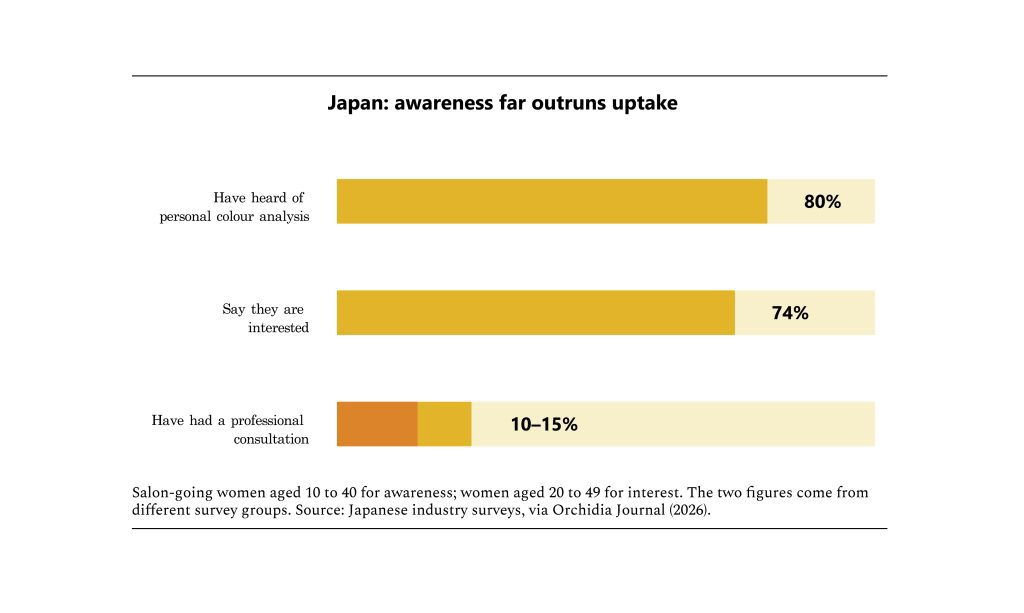
Salon-going women aged 10 to 40 for awareness; women aged 20 to 49 for interest. The two figures come from different survey groups. Source: Japanese industry surveys, via Orchidia Journal (2026).
That gap is being filled by everything short of a full session: online quizzes, filters, creator videos and apps that guess a season from a selfie. The seasonal labels have become a shared vocabulary, turning up in captions and bios much as star signs once did, and each label comes with its own community swapping product lists and outfit ideas. A diagnosis made once can keep shaping purchases for years.
Demand has given popular studios real pricing power. Travel guides advise booking two to three weeks ahead, especially in the spring and autumn tourist seasons. Many studios take payment or a deposit upfront, deduct lateness from the session and charge the full fee for a no-show, and English-language sessions can cost close to double the local rate. Those are the terms of a scarce product, not a novelty.
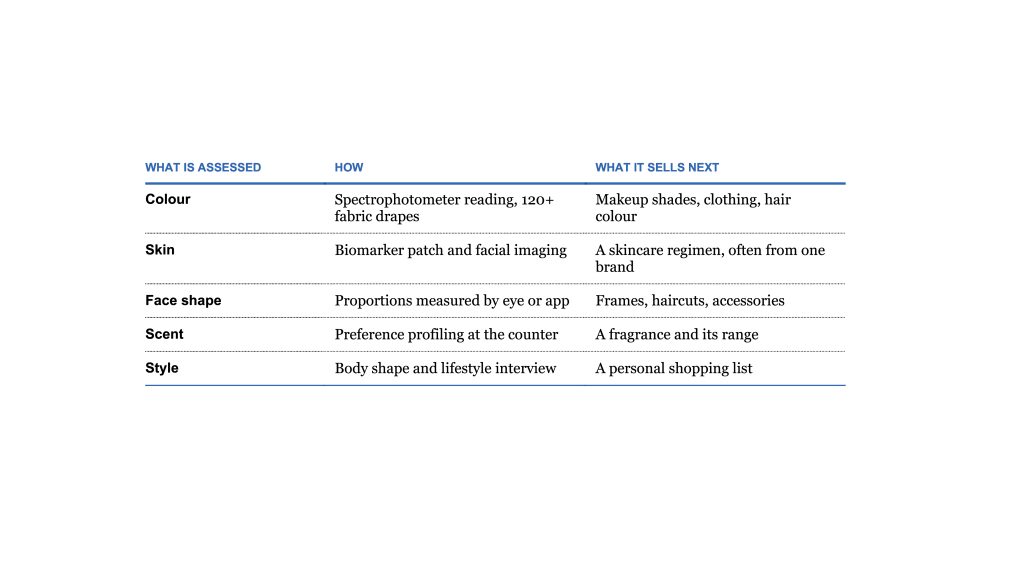
The format is spreading well beyond colour. Opticians recommend frames by face shape. Fragrance counters profile a customer’s tastes before offering a scent. Hair salons sell consultations as a service of their own, and fashion retailers offer style sessions that finish with a shopping list. The sequence rarely changes: assess, recommend, sell.
THE ASSESS-THEN-SELL MENU
How much of it is science?
Not all diagnoses deserve the same trust. A biomarker test measures something physical, and so does a spectrophotometer. Seasonal colour theory leans much more on the consultant’s eye, and clients do not always agree with it. One travel writer who tried a Seoul studio found herself disputing several of the calls, insisting that black suits everyone while her consultant steered her toward pale grey.
 The theory has drawn sharper criticism too, with some commentators warning that palettes built around skin tone can slide toward colourism if they are framed as fixing or lightening a complexion rather than matching it. Studios that take the work seriously describe undertone and contrast, warm or cool, soft or bright, and treat every type as equally attractive.
Some studios have also grown more careful about how they present results. One Hongdae salon sorts colours into three tiers, best, second-best and worst, and walks clients through why each shade works or fails, so the verdict reads as reasoning the client can check rather than a pronouncement.
None of this seems to dent demand, because a large part of what people pay for is the experience: an hour of close, expert attention paid to nobody but them. That is also what keeps customers loyal to a good tailor or barber, and it is hard to replicate with an app.
The same travel writer admitted that the results might end up sitting in her phone notes, unused until some future shopping trip. That may be the most honest test of the whole business. A diagnosis is only worth paying for if the customer goes on to shop by it, and the companies building this market are betting that, once people have been told what suits them, they will not want to go back to guessing.
Author: ANTARA ISLAM