For as long as we have seen in the last decade, Bangladesh’s digital marketing playbook has looked something like this: set up a Meta ad account, launch campaigns targeting Dhaka-based interest groups, watch the CTR rise, and hope conversions follow. As many of our early-stage and growth-hungry brands have experienced, this performance-first strategy has been both empowering and addictive. And why wouldn’t it be? The ability to launch a campaign in the morning and see results by evening feels like the magic of modern marketing.
But we’re seeing that the magic is wearing thin.
When we talk to founders, CMOs, or marketing managers today, we often hear frustrations with the recurring theme of poor economics: Cost-per-click is rising, ads are converting less, customer acquisition costs (CAC) are creeping dangerously high. Most importantly, the returns are starting to flatten. Many brands and businesses that rely primarily on performance marketing we work with are realizing that paid media is a game of diminishing returns – one that becomes prohibitively expensive if it’s not complemented by something more durable.
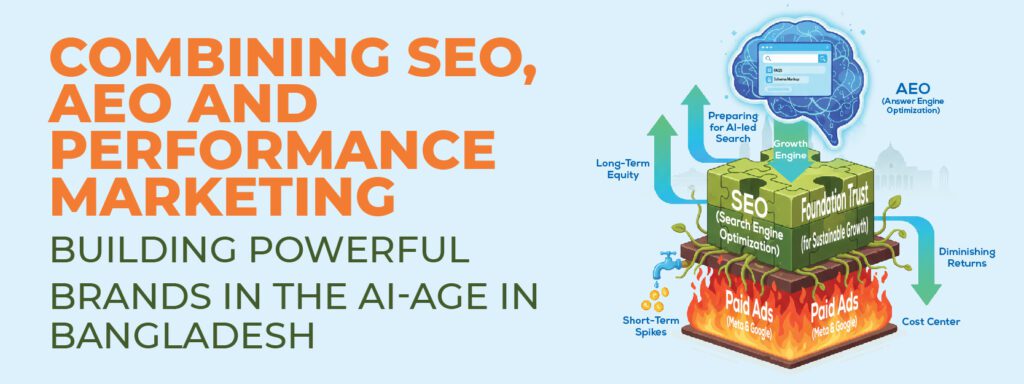
That’s why we believe the next phase of digital growth in Bangladesh isn’t about choosing between paid or organic, quick results or long-term equity. It’s about layering them strategically. We call this model Performance Marketing++: A deliberate fusion of paid ads, search engine optimization (SEO), and answer engine optimization (AEO).
Paid ads are just the starting point
Let’s get something out of the way at the outset: Paid advertising is here to stay and it is still a crucial part of the modern marketing mix. Platforms like Meta and Google offer crucial benefits like powerful targeting, granular control, and instant feedback. It’s the fastest way to test value propositions, drive traffic, and generate leads. In a highly volatile consumer habits and short attention spans space, this kind of agility is indispensable.
But we argue that paid ads are at best a short-term play as it doesn’t build something long-term. They function like a faucet in the sense that traffic flows only as long as the budget is turned on. The moment you pause spending, the reach vanishes. Worse, the same audience exposed to the same creative too many times begins to tune out.
As ad fatigue sets in and competition for impressions intensifies, brands have two options: spend more or get smarter. But smarter doesn’t mean abandoning paid – it means reinforcing it with assets that don’t disappear when the budget does.
That’s where our first (+) plus beyond performance marketing enters the scene: SEO. It enters the picture not as a separate channel, but as the foundational layer that makes every paid click work harder and last longer.
The first plus: SEO – The foundation for sustainable growth
Search Engine Optimization has long been misunderstood in Bangladesh. It’s often viewed as a slow, technical back-office function, or worse, a checklist to “get ranked on Google.” But at its core, SEO is how a brand earns attention rather than rents it. It’s about building authority, relevance, and trust – assets that compound over time.
Let’s take an example from our own experience. Take “Khaas Food” (the category pioneer for safe and unadulterated foods) in Bangladesh. From the very beginning, the company’s leadership combined paid campaigns with strong SEO execution. This allowed them to capture customers not just via awareness campaigns, but also through high-intent search queries like “organic food in Dhaka” or “safe broiler in Bangladesh.” Later, by retargeting these visitors with paid ads on Meta and Google Display, they were able to convert interest into action with greater efficiency. Today, Khaas Food enjoys strong brand recall in both paid and organic spaces as more than 40% of its online conversions come through organic searches – a direct result of our proposed layered, not linear, strategy.
Modern SEO also includes adapting to how users now search. With AI-powered tools like Google’s Search Generative Experience and Bing Copilot changing how results are presented, brands must optimize content for both traditional ranking and AI summarization. That means structuring content with FAQs, using schema markup, and ensuring clarity so that AI engines can understand, cite, and elevate it in answer-like formats. Early adopters of this approach (what’s being recognized globally as Answer Engine Optimization) are seeing disproportionate gains in visibility and trust, especially in zero-click search environments. That’s where our second plus (+) comes into foray.
AEO – the second plus: Preparing for the AI-led future of search
If SEO is about ranking on Google’s first page, AEO (Answer Engine Optimization) is about being the answer. With the rise of AI-powered discovery tools like ChatGPT, Google’s Search Generative Experience (SGE), Bing Copilot, and platforms like Perplexity AI (ChatGPT has become the third largest source of referral traffic for GEEKY Social in just the past six months and now contributes significantly to our lead generation efforts).
What does this mean for brands and marketers? It means that they need to evolve with the changes in technology as users are no longer just clicking through blue links. They’re asking questions and getting synthesized, AI-generated answers, often without ever visiting a website. This means that your brand not only needs to rank (using SEO) but also needs to be referenced (using AEO) as part of AI-led future of search. That requires a new kind of optimization:
- Structured content formats (like FAQs and schema markup)
- Clear, concise copy that aligns with search intent
- Authority signals such as backlinks and mentions
As we work with brands on a regular basis, our understanding is that most Bangladeshi brands are nowhere near ready for this shift. But that’s precisely why early movers will have the advantage. By preparing content today that AI engines can understand, cite, and elevate tomorrow, brands can future-proof their discoverability.
We would like to emphasize here again that AEO isn’t a replacement for SEO – it’s the next layer. And when layered strategically on top of paid and organic efforts, it becomes a competitive moat.
Summarizing the three layers of Performance Marketing++ Philosophy
The best way to think of Performance Marketing++ Philosophy is not as a sequential set of actions, but a stack:
Paid Ads (Meta & Google): Deliver fast results and allow for rapid iteration. Ideal for launches, offers, and retargeting.
SEO (Search Engine Optimization): Builds brand equity, lowers CAC, and provides sustainable traffic. It also improves the effectiveness of paid ads through better Quality Scores.
AEO (Answer Engine Optimization): Prepares your brand for AI-led search and zero-click discovery. Essential for the next 3–5 years of digital visibility.
Together, these layers create a digital growth engine that produces a holistic output. Each one reinforces the others – and none are optional for brands serious about scaling in today’s competitive environment.
On the global front, companies like Moz and Hubspot and Airbnb have long used SEO data to inform both their content and ad strategies. Airbnb, in particular, leverages AEO-friendly formats such as travel guides, community Q&As, and location pages so that their brand consistently appears in AI-generated travel recommendations.
In our experience of working with numerous Bangladeshi brands, too many digital marketing plans are built for this quarter. But the smart ones are built for the next five years. At GEEKY Social, we’ve seen firsthand how brands in Bangladesh can evolve their marketing from a cost center into a growth engine. The ones who win don’t just boost; they build. If your brand is ready to move beyond short-term spikes and start designing long-term success, now is the time to think Performance Marketing++.
Author: Mahadi Hasan Sagor & Md Saimum Hossain
Writers are co-founders of GEEKY Social Ltd (https://geekysocial.com)