Mastercard dropped its own name from its logo. BMW hired Hans Zimmer to give its silent electric cars a voice. As media goes audio-first and screen-everywhere, the logo is no longer the whole of a brand.
Two soft notes in the dark before a film begins. A gentle buzz against your palm the instant a payment clears. Five rising tones from a computer that has not shown you a single word. The crisp snap of thick chocolate breaking. None of these is a logo. None of them is anything you can see at all. And yet each is unmistakably a brand, recognised in a fraction of a second by millions of people who never had to look.
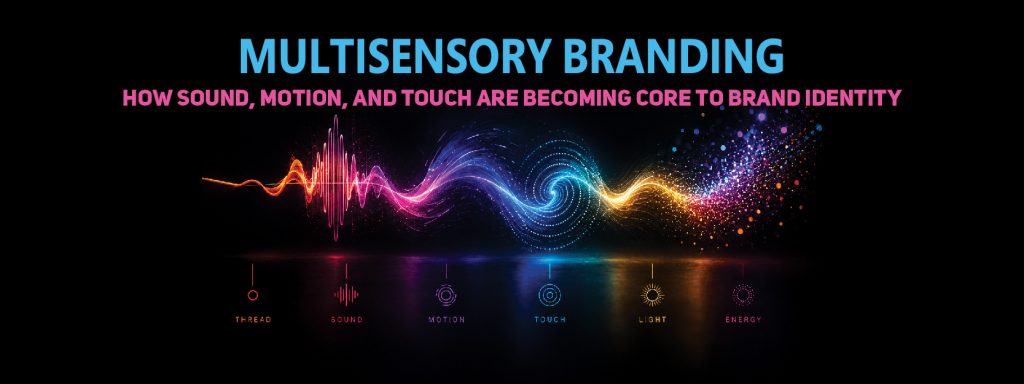
For most of the last century, a brand was something you looked at: a logo, a colour, a typeface, an arrangement of shapes on a page. That definition is quietly coming apart. As media moves to voice, to video, and to the small glowing rectangle in everyone’s hand, brand identity is spilling out of the visual and into the other senses. Sound, motion, and touch are no longer decoration applied at the end. For a growing number of the world’s most valuable brands, they are becoming the identity itself.
Beyond the logo
The shift is driven by a simple, awkward fact: people increasingly meet brands without looking at them. Ask a smart speaker to reorder detergent and there is no logo anywhere in the exchange. Listen to a podcast, scroll a muted video, feel a phone buzz in a pocket, and the visual identity that brands spent decades perfecting is simply absent. In those moments, a brand that cannot be heard or felt cannot be recognised. As one sonic strategist put it, if your brand meets its customers through a smart speaker, your visual logo is useless.
That has pushed sound in particular from a marketing flourish toward something closer to a product requirement, and the change has sharpened over the past two years. It helps that the senses are not equal in speed. The brain registers and reacts to a sound well before the eye has finished making sense of an image, which is why a two-second audio cue can land an emotional hit faster than any picture. In an economy where attention is measured in fractions of a second, that head start is worth a great deal.
The sound of a brand
Sound is where the revolution has travelled furthest, and the examples are everywhere once you start listening. Intel’s five-note “bong,” first heard in 2003, is recognised across languages with no word attached. Netflix’s cinematic “ta-dum” primes a viewer for what is coming before a single frame plays. McDonald’s whistled “I’m lovin’ it” travels across every market on earth.
The boldest move of all came from Mastercard, which in 2019 did something radical: it removed its own name from its logo, betting that its interlocking circles, and increasingly its sound, were recognisable enough to stand alone. It then built a whole sonic architecture around a short acceptance melody that now plays when a payment succeeds, and registered that sound not as a jingle but as a protected sensory experience. By the company’s own measure, checkouts carrying its sonic branding are roughly two-and-a-half times more effective in store, and four times more effective in apps, at reinforcing a sense of trust.
The data behind the trend is striking. One study found that sonic assets outperformed visual ones by almost three to one in bringing a brand to mind, and that advertising carrying a sonic logo was several times more likely to build brand salience. Attribution, the harder trick of making people remember whose sound it is, can be remarkable when it works: roughly seven in ten British consumers now connect the phrase “Did somebody say…” directly to the food-delivery brand Just Eat.
Some of the most interesting recent work happens where sound meets the product itself. When BMW began building electric cars that glide in near silence, it hired the film composer Hans Zimmer to design the sounds of ignition, acceleration, and braking, turning a safety necessity, since silent cars are a danger to pedestrians, into a piece of brand identity you feel through your spine. Porsche and Audi pipe engineered engine notes into their cabins for the same reason. Harley-Davidson, whose riders rebelled when quieter models lost the throaty rumble they loved, even tried to trademark the sound of its engine. In 2025 Magnum turned the sharp crack of its chocolate shell into a hero asset, recording it with the care a composer gives a melody. And Apple, as ever, runs an entire hidden language of sound, from the Mac startup chime to the click of an AirPod settling into place, each note tuned to feel expensive.
| SENSE | WHAT IT ADDS | MARQUEE CASE |
| Sound | Recognition with no screen; emotion in two seconds | Mastercard’s sonic logo; Netflix’s “ta-dum” |
| Motion | Identity that lives in a scrolling, video-first feed | The “motion-first” dynamic logo systems of 2026 |
| Touch | Confirmation you can feel; built-in accessibility | Mastercard’s haptic logo; Apple’s Taptic Engine |
Three signatures beyond the visual, and the brands proving each one out.
Brands in motion
If sound is the loudest part of the shift, motion is the fastest growing. Design strategists now describe the defining brand trend of 2026 as “motion-first,” and the logic is hard to argue with. A brand identity built for a printed page sits still; a brand identity built for a feed has to move, because the feed is where it now lives. The way a logo assembles itself, the way a button springs back under a thumb, the rhythm of an app’s transitions: all of it is becoming signature, codified in brand guidelines beside the colour palette and the typeface. A static mark in a scrolling river of video reads, more and more, as a brand that has not kept up.
The feel of a brand
Touch is the newest frontier, and the one that sounds like science fiction until you notice it is already in your hand. Mastercard, the pioneer again, built a haptic logo: a short composed pattern of vibrations synced to its sonic identity, so a shopper literally feels a transaction confirm. The benefit is not only distinctiveness. For blind and visually impaired users, a recognisable buzz is real accessibility, a way to know a payment cleared without seeing or hearing a thing.
This is no longer a fringe pursuit. By one industry estimate, more than half of all connected devices will be haptic-enabled by 2028, as the technology spreads from phones into watches, earbuds, game controllers, and cars. The principle designers have settled on is elegant in its restraint: let the screen carry the facts and let the buzz carry the confirmation, a small physical pulse that says, without words, it worked. Touch has always lived in the physical world of brands, in the weight of a premium box or the particular give of a glass bottle’s curve. What is new is that it has crossed into the digital, and become something a brand can design.
The whole greater than the senses
The point is not to collect senses like trophies. It is to make them agree. Branding strategists have a word for what happens when sound, sight, and touch reinforce one another: superadditivity, the finding that engaging two or three senses at once is not merely additive but exponential, far stronger than any one of them alone. Mastercard’s payment moment works precisely because the animation, the sound, and the vibration arrive together, each confirming the others, so that confidence is built in a single coordinated instant.
Brands have to do this now, with the oncoming of immersive media.
— Teemu Suviala, Global Chief Creative Officer, Landor
That coherence is also the discipline that separates strategy from gimmickry. A sound that contradicts the look, a motion that fights the tone, a buzz that feels wrong for the moment: each one erodes a brand rather than building it. The mature approach treats sound, motion, and touch the way good brands have long treated colour and type, as a governed system with rules and intent, not a box of novelties bolted on at the end.
The noise problem, and the machine
None of this is free of risk, and the biggest risk is noise. A sonic sting repeated too often curdles into an irritation. A generic, hummable jingle that could belong to anyone builds nothing at all. The old test of whether you could hum a logo back has become a poor guide, because some of the brands that sound strongest, Nike and Red Bull among them, own no bespoke jingle whatsoever, building their audio identity instead through a long, consistent relationship with music and culture.
Artificial intelligence sharpens both the promise and the peril. Tools that generate a passable sonic logo in minutes have collapsed the cost of entry, letting small brands find a voice they could never previously afford, and powering adaptive soundscapes that shift with the time of day or the individual listener. But when anyone can conjure a competent five-note motif on demand, the danger is a world of interchangeable ta-dums, none of them memorable. Tellingly, as AI floods the space, some of the most ambitious brands are moving the other way, toward raw, human, played-not-generated sound, precisely because authenticity has become the scarce thing worth paying for.
With your eyes shut
Stand in a shop, close your eyes, and let a payment go through. The animation you cannot see, the chime you can hear, the pulse you can feel: three signals, one brand, recognised without a single glance. That is the direction identity is travelling. The logo is not vanishing, but it is being joined, and at times outpaced, by the sound a brand makes, the way it moves, and the way it feels in the hand. The most recognisable brands of the coming decade will be the ones you could pick out with your eyes shut.
Author: Farisa Mahmud