Liquid Death sells water like a heavy-metal album. Duolingo killed its own mascot. In an internet too crowded to notice the safe, calculated strangeness has become a serious growth strategy, for the brands disciplined enough to pull it off.
On the morning of 11 February 2025, Duolingo did something no marketing textbook would advise. It killed its own mascot. The green owl that nags more than 100 million people to finish their language lessons appeared with X’s for eyes, was declared dead, and the company offered no explanation. Within a day, mentions of the brand spiked by roughly 25,560 percent. The hashtag #ripduo was used more than 45,000 times. A stunt that cost almost nothing outperformed Super Bowl advertisers who had spent millions.
This is the strategic case for weird, and it is sturdier than it looks. In an internet too crowded and too fast for anyone to notice the merely competent, calculated strangeness has become one of the most reliable ways to grow a brand. The catch, and it is a large one, is that weird is a discipline, not a personality. The brands winning with it are not being random. They are being precise.
Why safe became the riskiest play
Start with the problem weird is solving. The average person now meets thousands of commercial messages a day and has trained themselves to ignore nearly all of them. Feeds are infinite, attention spans have collapsed to seconds, and the cost of buying that attention keeps climbing. In that environment, the deadliest outcome for a brand is not to be disliked. It is to be unremarkable. Forgettable is fatal.
Most marketing is built to avoid mistakes, which is precisely why most marketing is invisible. A campaign engineered by committee to offend no one tends to interest no one. It is technically present and functionally absent, the advertising equivalent of beige. The safe choice, long treated as the responsible one, has quietly become the riskiest, because it guarantees the single result a brand cannot survive: being scrolled past.
The science of standing out
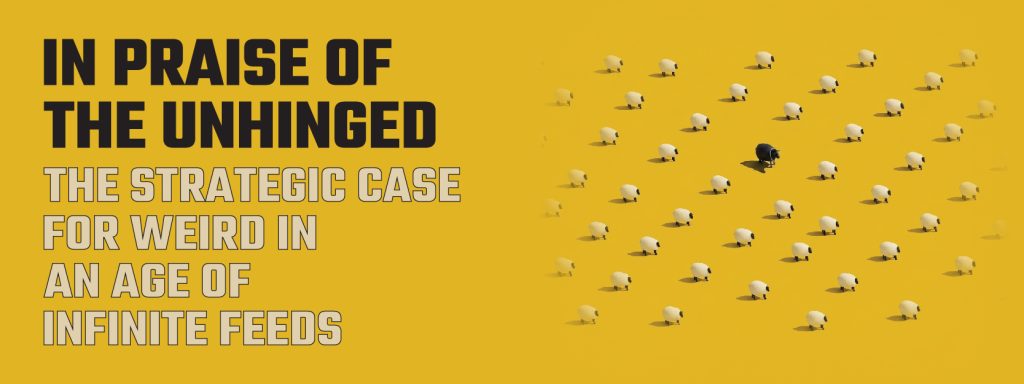
Weird works because of how memory is wired. Psychologists call it the Von Restorff effect, or the isolation effect: when one item breaks the pattern of everything around it, the brain flags it and holds onto it. A row of identical things is forgettable; the odd one out sticks. Liquid Death, a brand we will return to, leans on this so deliberately that its own marketers cite the effect by name. In a beverage aisle of serene blue labels promising purity and wellness, a black can that reads “Murder Your Thirst” is the thing your memory keeps.
There is a second mechanism, and it lives in the algorithm. Platforms reward engagement: the comments, shares, and screenshots, the impulse to send a thing to a friend with the caption “what.” Surprise is the raw material of all of it. Marketing scientists have shown that people share the content that provokes high-arousal emotion, the awe, amusement, and surprise that calm, competent, purely informative content never generates. Weird does two things at once: it sticks in memory, and it travels. Strange content stops the thumb and starts the conversation, and the conversation is what the distribution engine amplifies for free.
The brands built on the strange
The clearest proof is in the businesses constructed entirely on this logic. Liquid Death turned canned water, the most commoditised product imaginable, into a cultural object by marketing it like a heavy-metal band. Founded in 2019 by a former advertising creative, it sells still and sparkling water in tallboy cans that look like beer, wraps the whole thing in horror-movie humour, and ran a Super Bowl ad in which children and a pregnant woman appeared to drink from cans labelled like alcohol, before the twist revealed only water. The strategy carried it to a 1.4 billion dollar valuation by 2024, around 333 million dollars in annual retail sales, and shelf space in more than 133,000 US stores. By the company’s own count, its content has generated north of 20 billion social impressions, the overwhelming majority earned rather than bought.
Duolingo is the same playbook in software. Its “unhinged” social voice, built around a menacing, meme-ready owl, took the brand from 50,000 TikTok followers to more than 16 million in roughly four years. The dead-mascot stunt was its loudest moment, but the discipline behind it is the real story. The idea went from concept to launch in six days; the team crowdsourced the cause of death from the comments and settled on a Cybertruck because, as one staffer put it, it was simply ridiculous. When the Super Bowl came around, Duolingo refused to pay millions for a thirty-second slot and bought five seconds instead, timed to a push notification to every user, forcing people to rewatch the clip online just to work out what they had seen.
Others run smaller versions of the same engine. Nutter Butter turned its TikTok into a genuinely unsettling alternate-reality game, complete with cryptic characters and fans writing Reddit theories to decode them. Ryanair built a following by needling its own customers with a petty, gleeful tone no legacy airline could risk. And long before any of them, Old Spice rebooted a fading brand with a talking, horse-riding spokesman so surreal it invited a decade of parody. None of these were accidents. Each was a deliberate bet that being strange would beat being slick.
Make it fun. Make it weird.
— Luis von Ahn, CEO, Duolingo
When the dead-Duo concept was first sketched, von Ahn reportedly looked at it and pushed the team further with two more words: make it weirder. That instinct, coming from a founder rather than an intern, is the tell. The weirdness is sanctioned from the top, and it is aimed at a result.
| WHEN WEIRD WORKS | WHEN WEIRD BACKFIRES |
| The strangeness is linked to the brand | The gag overshadows the brand (the “vampire effect”) |
| It fits an underdog or youth-facing identity | It sits on an incumbent built on trust or prestige |
| Calculated, measured against business results | Chaos for its own sake, buzz with no goal |
| Surprises an audience that already gets the brand | Reads as a brand cosplaying spontaneity |
| Provocative, and stops before offensive | Crosses the line and torches earned trust |
The line between a breakthrough and an embarrassment is discipline, not daring.
| 50k → 16M Duolingo’s TikTok following in about four years, built on an “unhinged” voice rather than ad spend. (The Drum, 2025) |
Weird is a discipline, not a vibe
Here is where most imitators go wrong. They see the chaos and miss the control underneath it. Strategic weird obeys three rules, and breaking any one of them turns a bold campaign into an expensive embarrassment.
The first rule is that weird must be linked to the brand. The aim is not to be memorable in general; it is to be memorable as you. When a campaign’s strangeness overshadows the product, advertisers call it the vampire effect: the gag drains attention from the brand, and people remember the joke but not who told it. Duolingo could kill its mascot because the owl was already a character audiences knew and loved, so the stunt deepened an identity rather than borrowing a random one. Weird untethered from the brand is just noise with a logo attached.
The second rule is permission. Weird is not equally available to everyone. It suits underdogs, challengers, and youth-facing brands, the ones audiences already read as slightly anti-establishment and on their side. It sits badly on incumbents trading on trust and prestige. Ryanair can call a complaining passenger names and win applause; a premium airline selling safety and luxury would simply alarm its customers. A bank cannot go feral. A brand’s existing meaning sets the ceiling on how strange it can credibly be.
The third rule is that the chaos must be calculated. The brands that look most spontaneous are often the most controlled. Duolingo’s own leaders are blunt that they do not chase buzz for its own sake and that they measure everything against business results; the company even retains a “mascot safety” adviser, reportedly a veteran of Sesame Street, whose job is to flag when the owl’s antics risk tipping from cheeky into genuinely offensive. The randomness is a performance. The strategy beneath it is anything but random.
The graveyard
Survivorship bias is the weakest point in any “weird wins” argument, and it deserves naming. We remember the campaigns that worked and quietly forget the thousands that flopped: the brand accounts that tried to go feral and were mocked for corporate cringe, the stunts that read as a marketing team cosplaying spontaneity. For every Duolingo there is a Reese’s awkwardly debuting a creepy mascot one week and a celebrity the next, fooling nobody about how pre-approved the chaos really was.
The risks scale with the weirdness. Liquid Death itself had to publicly cut ties and apologise in 2025 after a campaign was filmed burning plastic waste near children, a reminder that the line between provocative and offensive is real and unforgiving. Jaguar’s stark 2024 rebrand split its audience and became a cautionary study in alienating the customers a brand already has. A misjudged stunt can do lasting damage to trust that took years to build. Weird is a high-variance strategy. It produces bigger winners and bigger losers than safe ever will, which is exactly why the discipline around it matters more than the daring.
When the feed fills with sameness
There is a reason the case for weird is sharpening rather than softening in 2026. Generative AI has made competent content nearly free. Feeds now fill with copy, images, and video that are polished, on-brief, and almost completely interchangeable, produced at a scale no human team could match. When anyone can generate a flawless, forgettable post in seconds, the flawless, forgettable post is worth nothing. Scarcity has moved.
What cannot be mass-produced is a genuinely strange idea with a point of view, the kind that makes a person screenshot it and ask a friend whether it is real. As the baseline rises toward uniform competence, the premium shifts to the work that breaks the pattern on purpose. Weird is becoming the clearest signal left that a human with taste and nerve was actually in the room.
It also explains why the winners keep their weirdness in-house and fast. Duolingo runs its social team with unusual autonomy and a one-week turnaround precisely because committee approval and agency layers sand the strangeness down to safe; its lead has said plainly that the team executes rather than waits two months for sign-off. Liquid Death built a whole brand voice no focus group would have greenlit. The instinct that produces breakthrough weird is fragile, and the process kills it. In an internet drifting toward automated sameness, protecting that instinct may be the most strategic thing a marketing team can do.
The safe option is the dangerous one
So, the question facing a marketer is not really whether to be weird. It is whether weird is available to their brand, and whether they have the nerve and the rigour to do it properly. For a challenger fighting for attention in a saturated category, calculated strangeness may be the single most efficient growth lever on the table, a way to earn the reach that rivals have to buy. For an incumbent built on trust, the same move could be reckless.
What has genuinely changed is the cost of caution. In a crowded, algorithmic internet, the safe campaign is no longer the low-risk one. It is the one most likely to be ignored, and being ignored is the only outcome a brand truly cannot afford. The brands winning right now understood that early. They were not being random. They were being weird on purpose.
Author
TASNIM SAFWAN