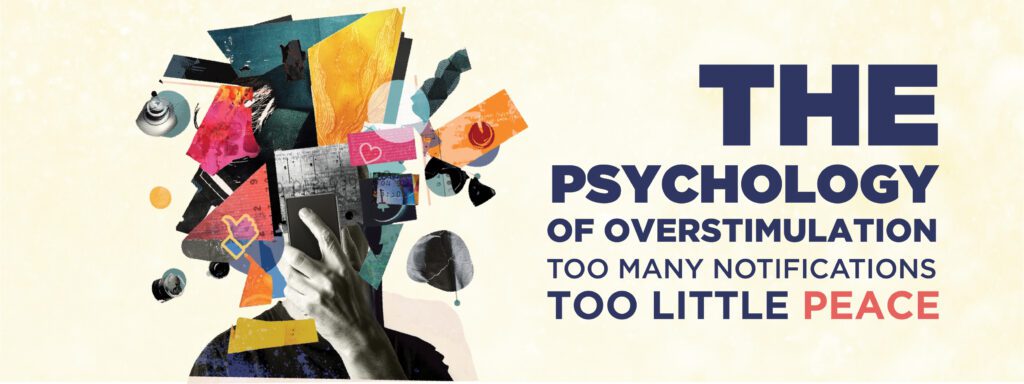
For years, mental health jargon has dominated talks. Look no further than “gaslighting,” which ushered in a new era of therapy-speak, as well as its synonyms “trauma,” “toxic,” and “triggered”—all of which are either oversimplified or erroneous. Perhaps you have noticed a recent addition when perusing through social media: “overstimulated.” People across the internet are reporting being overstimulated by new photographs of their favourite celebrities, weekends jam-packed with plans, grocery shops brimming with options, and the taxing duties of new parenting.
“I think people mean that there are too many things going on at once, and they feel overloaded by it—like task paralysis for your senses,” says Dr. Jessi Gold, chief wellness officer for the University of Tennessee System.
WHAT IT REALLY FEELS LIKE
Overstimulation, or “sensory overload,” is a term that refers to a scenario in which one or more of our senses become flooded with sensory input. When this occurs, the brain may undergo a fight-or-flight response, which can result in emotions of worry, anxiety, or panic. Powerful sensory stimulation, which can cause sensory overload or chronic sensory overload, may include powerful scents, bright or flashing lights, loud noises, crowds, or certain textures.
Though anybody can feel sensory overload, those with autism spectrum disorder, attention-deficit/hyperactivity disorder (ADHD), or sensory processing disorder may be especially vulnerable to overstimulation. Other mental health problems, including panic disorder, post-traumatic stress disorder (PTSD), and generalised anxiety disorder, have been linked to an increased risk of overstimulation.
“You are experiencing sensations, and you feel them more than they are,” says Naomi Torres-Mackie, a psychologist at Lenox Hill Hospital in New York City and the head of research at the charity Mental Health Coalition. “You may feel compelled to leave or escape; you may be restless and unable to settle down; you may experience anxiousness. You may have a panic attack, feel anxious, irritated, or rageful, and become extremely emotionally reactive.”
TECHNOLOGY SCRAMBLING OUR BRAINS?
Sounds like a conspiracy theory, but big tech companies are here to manipulate us. The tools we have been given are transforming us from masters of the tools to servants of the tools.
Take Netflix as an example. Humans have a limited amount of time to devote to activities, and their purpose is to fill those minutes while providing the customer with the maximum pleasure possible. Netflix CEO Reed Hastings views sleep as their number one competition. “You get a show or a movie you’re dying to watch, and you end up staying up late at night, so we actually compete with sleep,” he stated at the Summit of LA in 2017.
What we should do is become more mindful of how these technologies affect us. Or, as Carl Jung so eloquently stated, “Until you make the unconscious conscious, it will direct your life and you will call it fate.”
RECLAIMING YOUR MIND
When Torres-Mackie works with clients who identify themselves as overstimulated, she investigates what is producing the symptoms and how they affect the person’s daily functioning. “If you are feeling inundated with certain tasks and requests at work, and you’re still able to perform, you may be overwhelmed,” according to her. “But if you completely freeze, and you’re not able to perform—maybe you even have a panic attack—then you are likely overstimulated.”
If possible, remove yourself from the situation: Trust your instincts and get away from whatever is making you feel overwhelmed. If you are in a building, getting outside is the ideal option; however, leaving a noisy or crowded area will also suffice. If you are in a crowd outside, relocate to a secluded spot. Single-stall restrooms and automobiles are ideal for a quick, quiet escape.
Do box breathing: This technique was introduced to me by my therapist. If you cannot escape the overwhelming feelings, the most straightforward approach to cool down rapidly is to practice deep breathing exercises. Box breathing is the simplest deep breathing method to remember when you’re overwhelmed:
- Slowly and steadily inhale through your nose while counting to four.
- Hold your breath while counting to four.
- Exhale slowly and steadily through your mouth while counting to four.
- Continue this pattern for four minutes.
Get outside: A stroll in the park or your favourite route may be quite relaxing. When the hustle and bustle of daily life become overwhelming, taking some time to reconnect with nature can be incredibly therapeutic. Furthermore, studies have consistently shown that exposure to sunlight improves mood and energy levels.
Read a book: A little healthy escapism is essential for the soul, and nothing does it better than a good book. Furthermore, books are a great way to unwind. Research conducted by the University of Sussex found that individuals who read for just 6 minutes experienced slower heart rates, reduced muscular tension, and lower stress levels.
Focus on your body: When we talk about self-care, we often mean activities that bring us a sense of tranquillity or renewal, such as cooking, exercising, or engaging in a hobby. However, caring for your body is one of the most effective types of self-care. Take some time to pamper yourself; get a manicure, follow your preferred skincare regimen, apply cosmetics, or shave with a hot towel.
Take a bath: Speaking of self-care, a hot bath or shower can help you relax quickly and easily when you are feeling stressed. Immersion in warm water causes the production of serotonin, a neurotransmitter that governs mood, hunger, sleep, and social behaviour. Baths are also an excellent method to experience aromatherapy.
Listen to music: If you are not too overstimulated to appreciate some music, turn on your favourite soothing playlist and put on your headphones. According to Duquesne University, music can cause favourable physiological effects such as improved breathing, pulse, and blood pressure.
Stay off social media: When you are feeling overwhelmed and overstimulated, it is critical to avoid any activities that can aggravate your symptoms. Unfortunately, social media sites have gotten increasingly annoying over time. The globe is split on many subjects, and we are using social media to debate them.
According to Rutgers, 38% of social media users like and share political and social content. No matter where you land on the spectrum, you’re bound to see something that irritates or saddens you. When you’re already unhappy, this is the last thing you need. Take a vacation from social media until you feel more stable.
As we traverse this new cognitive terrain, it is critical to remember that we are the masters of our technology, not its servants. Understanding the hidden hazards of overstimulation and taking proactive steps to manage our digital lives enables us to harness the benefits of technology while preserving our humanity. The fate of our minds is in our control. Let us utilise them wisely, such as picking up a book, hugging a loved one, or just turning off our electronics and reconnecting with our surroundings. After all, the most important connections are not Wi-Fi signals, but those we make with ourselves and with others.