Start with the detail that should trouble anyone who works in this business. When CSG surveyed consumers about brand communication last year, 59 percent said they had deleted something genuinely important, a bill or a fraud alert, because it looked like marketing and they cleared it without reading. Almost two-thirds said they now worry about missing something critical for the same reason.
That is not a story about advertising being annoying. It is a story about a channel losing the ability to carry an urgent message, which is the only thing that made the channel worth having.
What the research actually found
The study behind those figures is worth describing properly, because the headline number has travelled further than its methodology. CSG worked with Wakefield Research on a survey of 1,200 people it called digital citizens, defined as anyone who had paid a bill online, used online support, placed an online order or managed an online account. Fieldwork ran from 24 July to 6 August 2025, with respondents split evenly across North America, Central and Latin America, and Europe, the Middle East and Africa. Asia Pacific was not included, which matters for anyone reading these numbers from Dhaka or Jakarta.
Within that sample, seven in ten said brands send so many messages that they no longer care what any of them say. More than a third had stopped buying from a company altogether because of excessive outreach. Only 48 percent felt brands genuinely deliver personalised experiences, while 50 percent said messages are useful only when they match something the customer recently did.
Katie Costanzo, who runs customer experience at CSG, framed the finding in commercial rather than emotional terms: consumer overwhelm is a business risk rather than a mood, and customers are not asking for more touchpoints. The recommendation that follows is intuitive. Send less. Send better.
The awkward counter-evidence
Here is where the argument gets genuinely difficult, and where most commentary on this subject quietly stops reading.
The performance data does not agree. Agencies running large direct-to-consumer email programmes report the opposite conclusion, arguing that most brands send too little rather than too much, that four to six emails a week is closer to optimal for e-commerce, and that a 0.3 percentage point rise in unsubscribes is a reasonable price for a double-digit gain in email revenue. One analysis of frequency effects found that a high-frequency programme produced 47 percent more revenue than a restrained one despite worse open rates, worse click rates, worse conversion and a lower average order value. Volume simply overwhelmed the decline in efficiency.
Both sets of numbers are real. They are measuring different things over different periods, and the disagreement between them is the whole subject of this article.
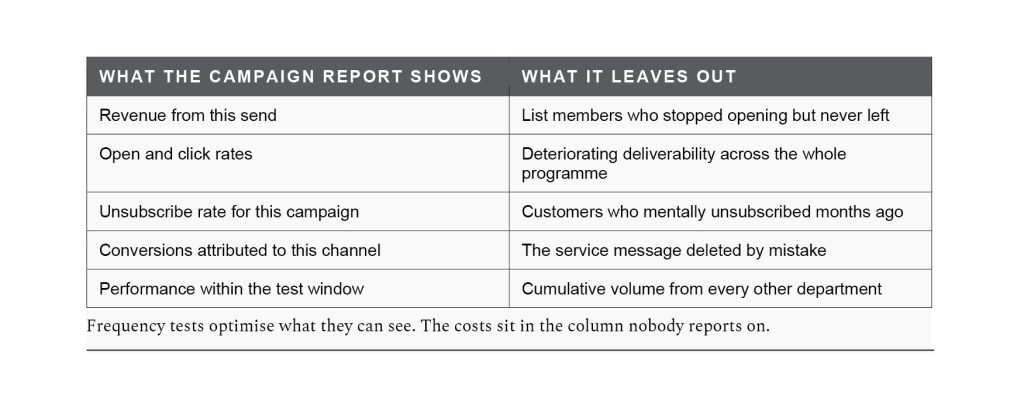
What the campaign report cannot see
A frequency test measures what happened to the people who received the emails during the test window. It captures revenue, opens, clicks and unsubscribes, and on those terms sending more usually wins, because a proportion of any list will buy when prompted and prompting is cheap.
What the report does not capture is more interesting. Email practitioners have a name for the first missing cost: opaque churn, the subscriber who never unsubscribes and never opens again. They remain on the list, inflating its apparent size, contributing nothing, and quietly worsening the engagement signals that determine whether future messages reach an inbox at all. Add ordinary list decay, which removes over a fifth of addresses in a year through job changes and abandoned accounts, and the asset being harvested is shrinking while the harvest report looks healthy.
The second missing cost is deliverability. Mailbox providers read low engagement as a spam signal, so a programme that trains its audience not to open is also training the platform not to deliver. At that point the frequency advantage disappears, and it disappears for the urgent messages as well as the promotional ones.
The third cost is the one CSG measured and the campaign report has no column for: the customer who deleted the fraud alert. No email programme in the world attributes that loss to itself, because the deletion happens to a different message, sent by a different department, weeks later.
It is worth being blunt about the commercial interests underneath this debate, because they run in opposite directions and neither party discloses them prominently.
CSG sells customer communications management software, and a finding that brands are overwhelming their customers with uncoordinated messages is a finding that brands need better coordination software. Meanwhile the agencies publishing frequency research sell email marketing services, and their revenue tends to scale with the volume of email their clients send. The consumer research argues for restraint from a company that profits from orchestration. The performance research argues for volume from companies that profit from volume.
None of that makes either dataset wrong. It does mean a marketer reading only one of them is being handed a conclusion rather than an argument.
 The constraint that just disappeared
There is a reason this problem is getting worse rather than settling, and it has nothing to do with anyone deciding to be more aggressive.
Volume was always limited by production cost. Writing a message, having it approved, building the creative and scheduling the send took a person a measurable amount of time, and that friction acted as a natural cap. A team could only produce so much, so it produced the things it judged most worth producing. The cap was accidental, but it functioned as editorial judgement.
Generative tools removed it. A marketing team can now produce a hundred variants in the time it used to take to write one, personalise each to a segment, and schedule the lot before lunch. Nothing about that capability is bad in itself. The difficulty is that the only brake on message volume was the effort required to create messages, and that brake has been released across every brand simultaneously, into the same finite inbox.
The customer, meanwhile, has gained no extra capacity to receive. CSG found that 51 percent of consumers particularly value messages that feel as though a real person wrote them, and 68 percent said they need to trust a brand before they will accept personalised messaging at all. Both findings point the same way. The supply of communication has expanded enormously; the willingness to receive it has not moved, and may be contracting.
What the better operators are doing
The practical resolution turns out not to be a number at all, and the brands handling this well have stopped arguing about how many is too many.
The pattern reported by practitioners is differentiated frequency: reduce volume sharply to subscribers showing low engagement while increasing targeting and relevance for the engaged, which produces lower total volume and higher total revenue at the same time. That combination is invisible to anyone running a single frequency setting across an entire list, which is still how a great many programmes operate.
Preference centres do similar work by moving the decision to the customer, and reported reductions in unsubscribes are substantial when brands promote them properly rather than burying the link. The logic is the same as one-click unsubscribe, which sounds like a concession and functions as protection: an easy exit stops a frustrated customer from reaching for the spam button, which damages the sender far more than a clean opt-out ever does.
The deeper fix is organisational and therefore harder. Most companies have no single view of how much they contact a person, because marketing, service, billing, loyalty and the app each send independently. The customer experiences the total. Nobody inside the building measures it. Until someone owns that number, every individual team can run a defensible frequency and the aggregate can still be indefensible.
What is actually scarce
The useful way to think about all of this is as a budget rather than a volume decision. Every customer relationship carries a finite amount of attention, and each message spends a little of it. Promotional sends draw down the balance. Genuinely useful messages, the delivery notification, the outage warning, the fraud alert, replenish it.
A programme optimised purely for revenue per send will spend that balance to zero, and it will do so profitably right up until the moment something matters. Then the company will discover it has trained a customer to ignore exactly the message it most needs read, and the cost of that discovery will land in a different quarter and a different department from the campaigns that caused it.
Which leads to the question worth putting on the wall of any team that runs a calendar. Not how many messages can we send before people complain, but how many can we send and still be believed when we say something is urgent. Almost nobody measures the second one, and it is the only number that determines whether the channel is still worth having in five years.
Sources: CSG, 2026 State of the Customer Experience Report, conducted with Wakefield Research among 1,200 digital citizens across North America, Central and Latin America and EMEA, fielded 24 July to 6 August 2025, released 28 October 2025 · Katie Costanzo, President of Customer Experience, CSG · CX Dive and CX Today reporting on the CSG findings · ATTN Agency, on email frequency optimisation for direct-to-consumer brands · Peasy, analysis of frequency effects on open rates and revenue · CMSWire, on diminishing returns in business-to-consumer email programmes (May 2026) · Opensend, e-commerce unsubscribe and list decay benchmarks (2026).
Author: Anata Islam