The marketing world has split into two camps, each armed with compelling data. On one side stand the advocates of vodcasts—video podcasts that combine the intimacy of audio storytelling with visual engagement. On the other, champions of short-form video ads on TikTok, Instagram Reels, and YouTube Shorts, who point to unmatched reach and viral potential. Global ad spending on short-form video is projected to reach $1.04 trillion in 2026, while vodcast and podcast advertising will hit $5 billion—a 20% year-over-year increase. Both formats deliver results, but they do so through fundamentally different mechanisms. For marketing directors allocating increasingly scrutinized budgets, understanding which delivers better ROI isn’t just academic—it’s existential.
The Trust Advantage: Why Vodcasts Command Premium Attention
Vodcasts have emerged as the trust leaders of digital advertising. According to a 2025 SuperListeners Study, 62% of podcast fans trust ads read by their favorite hosts, compared to just 15% who trust social media influencers. This gap translates directly into purchasing behavior. Host-read ads deliver a 71% brand recall rate according to Edison Research and Ad Results Media—dramatically higher than the less than 10% recall rate for social media ads that users scroll past. The intimacy of the format explains the premium: listeners develop what psychologists call a “parasocial relationship” with hosts, hearing the same voice in their ears for hours each week during commuting, exercise, or household chores.
The video component amplifies this connection. Deloitte reports that vodcast watchers consume 1.5 times more content than audio-only podcast listeners, while 44% of vodcast viewers say they don’t multitask while watching—compared to just 29% of audio podcast listeners. This focused attention represents a marketer’s dream: an audience that actually watches ads rather than treating them as background noise. As of August 2025, 79% of monthly podcast listeners worldwide watch video podcasts at least some of the time, with 27% consuming audio and video equally. YouTube now boasts one billion monthly vodcast viewers and set a Guinness World Record in August 2025 when “New Heights” attracted 1.3 million concurrent viewers for a single episode.
The Scale Imperative: Short-Form Video’s Unmatched Reach
Short-form video offers something vodcasts cannot match: explosive, algorithm-driven distribution. TikTok delivers engagement rates of 2.80% in 2024, projected to reach 3.15% in 2026—numbers that dwarf other platforms. YouTube Shorts leads with an engagement rate of 5.91% and generates over 200 billion views daily. Instagram Reels has seen engagement grow 25% since 2021. These platforms have fundamentally rewired how humans consume digital content, with video projected to comprise 82% of all global internet traffic. Some 73% of consumers now prefer short-form videos to search for products or services, while 57% of Gen Z specifically prefer short videos to learn about products.
The algorithms create unprecedented opportunities for unknown brands to reach massive audiences overnight. TikTok’s “For You” page uses machine learning to predict engaging content regardless of follower count, while YouTube Shorts benefits from integration with the world’s second-largest search engine, providing discoverability that extends weeks or months beyond initial posting. Short-form videos receive 2.5 times more engagement than long-form videos, and 85% of marketers now say short-form is the most effective format on social media. For brands seeking rapid awareness at scale, the math is compelling: TikTok provides access to 1.59 billion users, Instagram Reels reaches 2.8 billion, and YouTube Shorts commands 2 billion monthly active users.
The ROI Equation: Comparing Cost Per Acquisition
When the numbers are examined closely, vodcasts demonstrate superior conversion economics despite higher upfront costs. According to Podsights, podcast ads achieve an average conversion rate of 1.32% to website visits—compared to 0.90% click-through rates for Facebook and Instagram ads. A 2025 Claritas study found podcast ads generate up to three times higher brand recall and 1.5 times higher conversion rates than traditional digital audio. The long-term return on ad spend is particularly striking: podcasts deliver a long-term ROAS of 4.9, meaning $1 invested today yields $4.9 in long-term sales. Host-read ads convert at rates two to three times higher than pre-produced spots, and 63% of listeners have purchased something a host discussed.
Short-form video tells a different but not necessarily inferior story. Some 21% of marketers say short-form video delivers their highest ROI, while Instagram Reels delivers e-commerce conversion rates 1.3 times higher than TikTok. Retailers implementing shoppable video features have seen conversion lifts of 30% or more. The CPM economics favor short-form: TikTok averages approximately $10 CPM compared to $12 for Instagram Reels, while podcast CPMs range from $18 to $50 for standard placements and can exceed $35 for niche audiences in finance or B2B technology. However, the lower CPM must be weighed against shorter ad exposure—a six-second YouTube pre-roll versus a 60-90 second podcast endorsement that tells a complete product story.
Attention Quality: The Hidden Variable
The most consequential difference between formats may be attention quality. Podcast ads score 56% higher on attentiveness metrics than other formats, and over 90% of podcast listeners finish entire episodes—creating consistent, low-distraction environments for advertisers. Edison Research reports that 86% of respondents recall seeing or hearing podcast ads, compared to 80% for social media and 79% for websites. Host-read podcast ads deliver up to 4.4 times higher brand recall than display or social media advertising. Some 80% of listeners say they will consider a product or service promoted by their favorite host, and 72% say podcast ads hold their attention more than any other media.
Short-form video operates on different attention mechanics. Videos under 90 seconds retain 50% of viewers—impressive for social media but far below podcast completion rates. The “thumbstop rate”—the percentage of viewers who watch past three seconds—has become a critical metric as platforms optimize for engagement over depth. While viewers retain 95% of a message conveyed through video, the message itself is necessarily compressed. A TikTok ad delivers its value proposition in seconds; a podcast sponsor can explain product benefits, share personal use cases, and build genuine advocacy over a full minute. For complex products or services requiring education, the difference is substantial.
Audience Dynamics: Who’s Watching What
The platforms serve distinct but overlapping demographics. Some 66% of podcast listeners ages 12-34 tune in monthly, making podcasts particularly attractive for brands targeting Millennials and Gen Z. YouTube and Spotify are the top two networks for weekly podcast reach among Gen Z, confirming how entertainment, education, and creator economies are merging. Vodcasts specifically attract younger viewers: 27% of U.S. consumers watch vodcasts weekly, according to Deloitte’s Fall 2025 Digital Media Trends report, with the trend led by Gen Z and millennials. Spotify now has over 60% of its most popular shows offering a video component.
Short-form video skews even younger: TikTok is used by 82% of Gen Z not just for entertainment but also for search, shopping, and learning—functions traditionally owned by Google. Android users spend an average of 35 hours per month on TikTok alone. However, Instagram Reels attracts an older, purchase-ready audience: 65% of Reels users aged 28-43 shop for lifestyle, fitness, or home decor products while watching. Facebook Reels reaches users 25-34, who make up 31.1% of its audience. The strategic implication is clear: brands can target specific age brackets through platform selection, with TikTok for Gen Z awareness and Instagram Reels for millennial conversion.
The Measurement Challenge
Attribution remains a significant challenge for both formats, though podcast measurement has improved dramatically. In 2026, podcast ad performance is more measurable than ever through pixel-based attribution, custom promo codes, and third-party platforms like Podscribe. However, only 49% of marketers feel confident measuring podcast ROI, intensified by the fact that 71% of listeners multitask during episodes. The advantage of podcast attribution is its longer measurement window. Unlike social media, where engagement peaks within 24-48 hours, podcast listeners often purchase later, after multiple episode exposures or cross-channel reinforcement.
Short-form video provides more immediate but potentially misleading metrics. Platforms offer robust analytics. TikTok Analytics shows retention and follower activity. Instagram Insights highlights engagement patterns, and YouTube Analytics tracks traffic sources—but the connection to actual sales can be elusive. Cost per acquisition for podcast campaigns typically lands between $50-$150, depending on offer and funnel, while short-form video CPA varies wildly based on creative quality and targeting. The critical insight for marketers: neither format offers perfect attribution. However, podcast measurement increasingly connects exposure to conversion through sophisticated tracking infrastructure.
The Verdict: Different Tools for Different Jobs
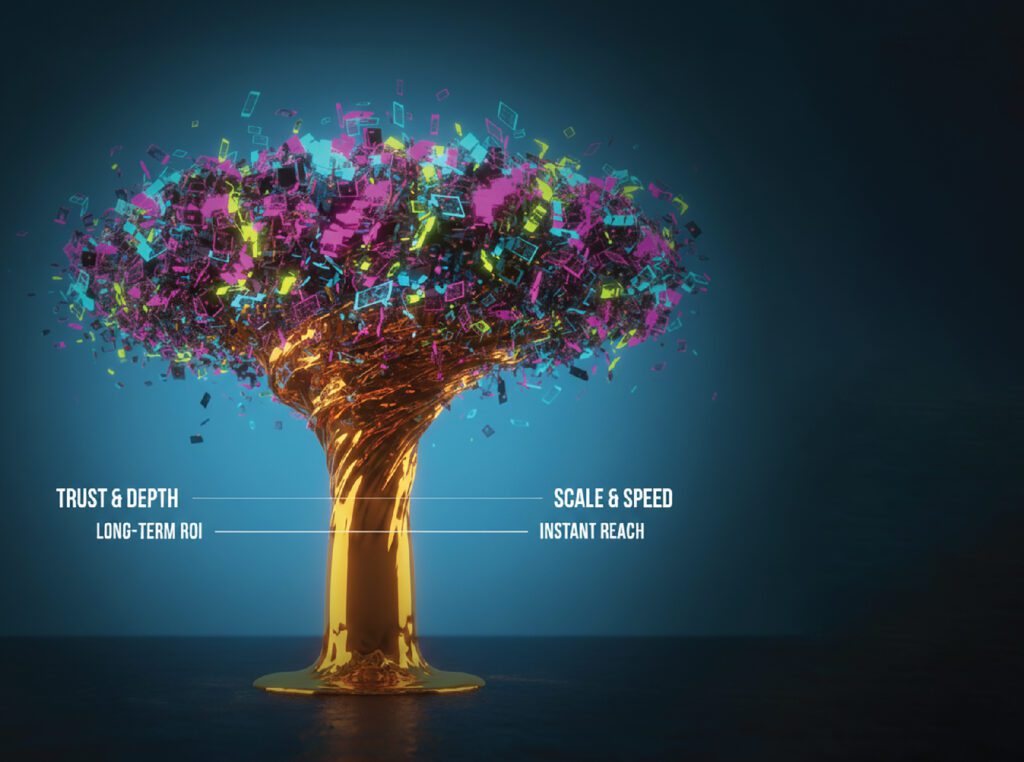
The data suggests neither format is universally superior—they excel at different marketing objectives. Vodcasts deliver unmatched trust, recall, and conversion efficiency for brands prioritizing customer quality over quantity. They work best for complex products requiring education, premium positioning demanding credibility, and long-term brand building, where lifetime customer value justifies higher acquisition costs. The $5 billion flowing into podcast and vodcast advertising in 2026 reflects advertiser recognition that some messages require depth and authenticity that 15-second clips cannot provide.
Short-form video remains essential for rapid awareness, viral potential, and reaching audiences where they already spend hours daily. The $1.04 trillion in global ad spending reflects the format’s proven ability to generate massive reach efficiently. The smartest marketers are discovering that hybrid campaigns—using both video and audio—yield 23% higher ROI than single-format approaches. The future belongs not to those who choose sides but to those who deploy each format strategically. Short-form for top-of-funnel awareness and cultural relevance, vodcasts for bottom-of-funnel conversion and trust building. In 2026, the question isn’t which format wins—it’s how to make them work together.