The 2026 World Cup kicks off on 11 June. The marketing tournament started months ago. Inside the build-up economy — the teasers, the jersey drops, the TikTok hype, and the second-screen battle — and what it means for brands in a country that isn’t playing but is watching as hard as anyone on earth.
On rooftops across Dhaka, the flags are already up. Sky-blue and white over one building, yellow and green over the next, the Argentina-Brazil geography of the city redrawing itself the way it does every four years, weeks before a single match has been played. In the jersey shops of Gulistan and the online stores that ship a Messi shirt for 1,100 taka, the 2026 kits have been selling since November, when Adidas dropped the home strips for 22 nations at once. Bangladesh is not in the World Cup. Bangladesh has never been in the World Cup. And yet by the measure that matters to marketers — attention, emotion, money changing hands — few countries on earth are more deeply in it than this one.
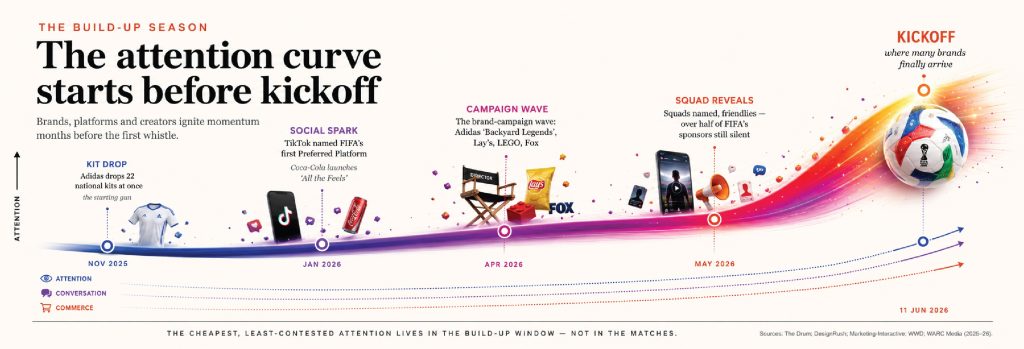
That paradox is the most interesting thing about the World Cup as a marketing event, and it is worth sitting with before the tournament begins. The 2026 edition, kicking off on 11 June across 16 host cities in the United States, Mexico, and Canada, is the largest in history: 48 teams, 104 matches, three host nations, the first time the tournament has been split across three countries. WARC Media estimates brands will pour an additional $10.5 billion in global ad spend into the second quarter of 2026 on the back of it. FIFA expects the highest partnership revenue ever recorded for a sporting event — around $1.8 billion in sponsorship alone. But the spending that defines whether a brand wins or loses its World Cup is not happening during the matches. It is happening now, in the build-up, in the weeks before the football starts.
The build-up has become its own marketing season — a distinct phase with its own logic, its own battleground, and its own winners and losers, largely settled before the opening whistle. Understanding how that season works, who is playing it well, and what it means for brands in Bangladesh is the subject of this piece.
The build-up is the battleground
For most of World Cup history, the marketing model was simple: build one big, cinematic, expensive film, launch it close to kickoff, and ride the tournament’s attention. Nike’s 2014 Risk Everything and Winner Stays campaigns are the genre’s monuments — lavish hero films that defined how brands showed up at a World Cup. That model is being dismantled in 2026, and the reason is instructive. A single hero film launched at kickoff captures a moment. It does not sustain presence across a 39-day tournament, and it does nothing to claim the build-up window where anticipation — and the cheapest, least contested attention — actually lives.
Adidas understood this first. Its La Preparación Americana campaign, one of the earliest tied to the tournament, deliberately focused on the build-up rather than the spectacle — a cinematic film about preparation, training, and discipline, featuring Messi, that arrived while most official sponsors had released nothing at all. That timing was the strategy. As of the weeks before kickoff, more than half of FIFA’s 20 official sponsors — including McDonald’s and Kia — had still not launched anything. The brands already in the market had effectively shaped how the tournament felt to audiences before their competitors had said a word. In a contest for attention, arriving first is a structural advantage, and the build-up is where that advantage is claimed.
The economics reinforce the logic. Television and connected-TV inventory during the matches themselves is limited, fiercely contested, and priced accordingly — out of reach for most brands and expensive even for those who can afford it. The build-up window, by contrast, is open. A brand that builds anticipation in May reaches an audience that is already emotionally invested but not yet saturated with tournament advertising, at a fraction of the cost of an in-match slot. The build-up is not a warm-up for the real marketing. For most brands, it is the real marketing.
|
BRAND |
CAMPAIGN |
THE BUILD-UP PLAY |
|
Adidas |
La Preparación Americana |
First major campaign out of the gate. A cinematic build-up film centred on preparation and discipline rather than the tournament itself — featuring Messi, with three legends de-aged using AI. |
|
Coca-Cola |
All the Feels / Real Magic |
Launched at the start of the year. Built around shared fan emotion rather than players or matches, positioning the brand as the constant companion across the whole tournament journey. |
|
Nike |
Multi-week rollout |
A sustained sequence built to hold presence across the full 39-day tournament rather than peaking with a single hero film — a deliberate move away from the one-big-ad model. |
|
Lay’s / LEGO / Fox |
Fan-first creative |
Each built its campaign around the fan’s experience rather than the brand’s, and each earned outsized attention for it — the clearest pattern in what is working early. |
|
Mastercard |
La Colección Diez de Diez |
A limited-edition collection of 10 custom jerseys inspired by the 10 chapters of Messi’s career — merchandise as storytelling, scarcity as message. |
Early World Cup 2026 build-up campaigns and their strategic approach. Sources: The Drum, DesignRush, Brand Innovators Ad Tracker, WARC Media (2026).
The craft of the tease
If the build-up is the battleground, the tease is the weapon. The art of building anticipation without showing the product — or the match, or the moment — has become central to how brands operate in the pre-tournament window, and the best campaigns of 2026 are studies in restraint as much as spectacle. Coca-Cola launched its All the Feels campaign at the start of the year, built not around players or matches but around the texture of fan anticipation itself — the everyday moments overtaken by pre-tournament excitement. The campaign’s logic is that the waiting, the building, the anticipation, is itself the product worth selling, and that a brand which owns the feeling of the build-up owns something more durable than a brand which only shows up for the final.
The build-up calendar gives brands a sequence of triggers to work with, each one a marketing moment in its own right. The kit launch. The squad announcement. The qualification confirmation. The pre-tournament friendly. Each of these has become an occasion for activation, a beat in a months-long rhythm that brands choreograph their campaigns around. When Adidas dropped 22 national kits in a single November release, it was not merely selling shirts — it was firing the starting gun on the build-up season and giving fans something to anticipate, discuss, and buy long before any football was played.
The discipline the tease requires is real, and not every brand manages it. Coca-Cola, which has executed the emotional build-up beautifully in its main campaign, also drew backlash for an AI-generated spot called Uncanned Emotions — a reminder that the build-up is a high-visibility window where missteps are as amplified as successes. The lesson the early 2026 campaigns teach is consistent: the brands that build anticipation around the fan’s experience, and that give audiences a role rather than a logo to look at, are the ones converting the build-up into attention that lasts into the tournament itself.
The hype lives on social — and this year, on TikTok
The single most consequential structural shift in how the 2026 World Cup will be marketed is the naming of TikTok as FIFA’s first-ever official Preferred Platform. The deal, announced in January 2026, gives selected TikTok creators credentials to capture behind-the-scenes content, press conferences, and training sessions — institutionalising the fan-creator perspective as part of the tournament’s official narrative apparatus for the first time. The second screen, as one analyst put it, has become the preferred screen.
The data behind that decision is striking. According to TikTok’s own metrics, fans are 42% more likely to tune in to a live match after watching sports content on the platform — a figure that reframes social media from a place where the tournament is discussed into a channel that actively drives match viewership. Fifty-nine percent of TikTok users say that watching sports content on the platform is often more entertaining than the games themselves. For a generation of younger and female fans that traditional broadcast has struggled to reach, the social conversation is not a supplement to the tournament. It increasingly is the tournament.
What this means for brands is that the build-up hype is being built, distributed, and amplified on social platforms before and during the tournament in ways that the old broadcast-centric model never accommodated. Tubular Labs research on social video behaviour ahead of the tournament found that short-form video under 30 seconds accounted for 40% of all World Cup-related YouTube uploads — and that fan-driven content, reaction edits, and creator commentary frequently outperform official clips. The EURO 2024 tournament demonstrated the pattern clearly: fan reaction edits and explainer content on TikTok regularly beat the official footage for engagement. The brands that win the social build-up are not the ones with the most polished films. They are the ones that give fans something to remix, react to, and make their own.
The second screen is where the match is actually watched
The build-up is preparation for a tournament that audiences will experience across at least two screens simultaneously, and the brands planning their World Cup marketing now are planning for that reality. In the United States alone, eMarketer forecasts that 216.8 million adults — 80.6% of the population — will use a smartphone as a second screen this year. Across Southeast Asia, more than 90% of users report using their smartphones while watching live events on television. The match plays on the big screen; the conversation, the reactions, the searching, the buying, and increasingly the advertising, all happen on the small one in the viewer’s hand.
This fragmentation is an opportunity rather than a threat for brands priced out of in-match television inventory. The viewer who cannot be reached affordably during the broadcast can be reached on the second screen — through social content, real-time reaction, and the surrounding conversation — at a fraction of the cost. Around 31% of sports fans use a second screen specifically to engage on social media while watching live events, which means a brand’s in-match presence no longer requires a television slot at all. It requires a presence in the conversation that the match generates, and that presence is built in the weeks before, when the audience and the brand’s relationship to it are established.
The implication for build-up strategy is direct. A brand that has spent the build-up window establishing itself in the fan’s social feed, that has given fans content to share and react to, arrives at the tournament with a second-screen presence already built. A brand that waited for kickoff to start its marketing arrives to find the second screen already occupied. The build-up is where the second-screen battle is won, weeks before the first match is played.
Marketing to a nation that isn’t playing
Which returns us to the rooftops of Dhaka — and to a fandom that runs far deeper than seasonal colour. On the night of 18 December 2022, the courtyard of Dhaka University’s Teacher-Student Centre held a crowd that erupted as one when Messi opened the scoring against France; the same scene played out on giant screens from Gulistan to district towns, hundreds of thousands of Bangladeshis in Argentine blue and white watching a final their own country had no part in. FIFA posted the Dhaka celebrations to its own channels, marvelling that few things on earth unite people the way football does. The passion is neither new nor shallow. Bangladesh has followed Argentina since Maradona’s 1986 triumph — a win sealed against England, the country’s former coloniser — and when Maradona died in 2020, a minute’s silence was observed at domestic cricket matches, in the nation’s own sport. This is the most intense expression of borrowed national identity anywhere in the world, and it is exactly what makes Bangladesh one of the most valuable World Cup markets on earth for a brand that knows how to enter it.
That depth of feeling is what Bangladeshi brands are built to convert, and the 2026 build-up shows the playbook clearly. Coca-Cola Bangladesh, riding the momentum of its national Trophy Tour, launched a months-long campaign in April that runs to mid-July: specially marked 1.75- and 2-litre bottles carry codes that unlock World Cup quizzes, points and weekly leaderboards, with match-hospitality experiences and official merchandise as prizes and a Facebook-sharing mechanic to widen the reach. The structure is telling — not an instant-win lottery but a sustained engagement loop built to hold the fan across the whole tournament rather than spike once. Around it sits the older Bangladeshi habit of owning the act of watching itself: Nagad’s giant LED screens at the TSC, which drew crowds for the 2022 football and again for the 2023 cricket World Cup, and Banglalink’s Toffee platform, which in 2022 streamed a World Cup on mobile in Bangladesh for the first time. The brands that win here are not selling the tournament. They are selling belonging to it.
Nowhere is that commerce more visible than in the jersey trade. In the weeks before kickoff the wholesale stalls of Gulistan and the markets of New Market, Mouchak, Mohakhali and Farmgate become a seasonal economy of their own — Argentina’s blue-and-white leading sales, Brazil’s yellow close behind, and Germany, France and Portugal moving in volume too. Online retailers like Jersey Club BD and Jersey Freak BD ship Thai-premium kits — the player edition for the athletic cut, the cheaper fan edition for everyday wear — for around 1,100 taka, while prices climb steeply as the fever builds: in 2022, jerseys selling for roughly 550 taka one week were fetching 1,200 to 1,400 the next. It is an entire commerce wave built on a tournament Bangladesh will watch rather than play, and it begins, like everything else, in the build-up.
The clearest proof of how legible that passion has become lies in what it has pulled into being. In February 2023, Argentina reopened its embassy in Dhaka after 45 years — it had been shut since 1978, under the country’s military dictatorship — with its foreign minister arriving alongside a delegation of some twenty business leaders and signing a football-cooperation agreement to help train young Bangladeshi players. Argentine officials said plainly that the fervour of Bangladeshi support during the 2022 World Cup had accelerated the decision. Soon after, bKash became the reigning world champions’ first and only Bangladeshi brand partner — a fintech from a country eight thousand kilometres away, and not in the tournament, signed by the Argentine Football Association precisely because its fans had made themselves impossible to ignore. A fandom that moves an embassy and a sponsorship is not one a marketer can treat as a footnote.
There is, this time, a live complication that sharpens the whole question. As of the final weeks before kickoff, no Bangladeshi television channel or streaming platform had secured the 2026 broadcast rights — they sit with a Singapore-based company — leaving real uncertainty about how a nation of some 170 million will actually watch. In a market where the second screen and the communal big screen have often mattered more than the household television, that uncertainty is itself an opening. The brand that has built a presence in the social conversation, on Toffee-style streaming and around the public screenings does not depend on a broadcast deal being struck in time; it has already met the fan where the fan will be.
The caution is the same one facing global advertisers, intensified by the borrowed nature of the loyalty: the allegiance is to the team, not the brand, and a campaign welded to one nation’s run is exposed the moment that nation goes out. Tie everything to Argentina lifting the trophy, and a quarter-final exit deflates the entire activation. The more durable move — the one the strongest build-up campaigns are making everywhere — is to align with the fan’s experience rather than the result: the rooftop flags, the rivalry, the shared ritual of the group-stage nights, the communal joy of watching. In Bangladesh, that experience is guaranteed regardless of who wins. The team may go home early. The fandom never does.
The 2026 World Cup will produce a champion in mid-July, and a great deal of marketing analysis will follow about which brands won the tournament. Most of that analysis will be looking in the wrong place. The brands that win the World Cup will have won it in the months before it started — in the teasers that built anticipation, the jersey drops that turned commerce into culture, the TikTok content that gave fans something to share, and the second-screen presence established before the first match. By the time the tournament begins on 11 June, the marketing contest will be largely decided. In Dhaka as much as anywhere, the flags are already up, the jerseys are already selling, and the brands that understood the build-up have already made their move.